
 The 2017 Genitourinary (GU) Cancer Symposium kicked off on February 16th in Orlando, Florida, bringing together more than 3,000 attendees from all over the world. At this annual conference, clinicians from a wide range of disciplines treating people with prostate cancer, kidney cancer, bladder cancer, and testicular cancer come together to hear from experts on the latest scientific discoveries and how they impact clinical care for patients.
The Weill Cornell Medicine (WCM) and NewYork-Presbyterian (NYP) GU Oncology team is down in the Sunshine State highlighting the cutting-edge research and patient care that has been taking place back on campus in New York City.
 Team member Dr. Bishoy Faltas was selected by the conference to be a “Featured Voice” on Twitter, so be sure to follow him (@DrFaltas) for updates in real-time. Dr. Scott Tagawa (@DrScottTagawa) is now on Twitter too and also tweeting live from the symposium. The official conference hashtag is #GU17.
Some #GU17 highlights
Day 1 – The initial session focused on active surveillance for prostate cancer, including using both imaging as well as tissue biomarkers to help select optimal patients for surveillance versus those who should undergo surgery or radiation. A subsequent session focused on prostate cancer that progresses despite therapy and the pathways of resistance that can develop. This included a discussion of prostate cancer subtypes that become independent of the androgen-receptor (hormonal) pathway, including aggressive variant and neuroendocrine prostate cancer (NEPC). Neuroendocrine prostate cancer is one of the most aggressive and treatment-resistant types of prostate cancer that most often evolves from prior hormonal therapy.

Dr. Gerhardt Attard at the Institute of Cancer Research in London, gave a great talk on the value of circulating tumor DNA in prostate cancer. He spoke about the collaborative grant from the Movember Foundation and the Prostate Cancer Foundation (PCF) that he, Dr. Misha Beltran and others have used to develop signature ways to confirm neuroendocrine prostate cancer with a blood test. An additional collaborative grant will allow optimization of this technology across a larger number of centers. Learn more about this prestigious Movember Foundation-PCF Challenge Award and how we’re using genomic characterization of tumors in less invasive ways in order to bring precision medicine – or narrowly tailored, personalized treatment – to more patients.
 Dr. Evi Giannakakou explains to a crowd of physician-scientists results from our TAXYNERGY clinical trial showing additional evidence of using cancer cells circulating in the blood, also referred to as circulating tumor cells or CTCs, as a primary biomarker for chemotherapy response. This research validated prior work regarding the mechanism of action of chemotherapy in prostate cancer and demonstrates that using a simple blood draw, within one week of first chemotherapy treatment, we’re able to determine whether men with metastatic prostate cancer have a higher chance of responding. In the future, this might spare men from additional treatment (with associated side effects) with a drug that has a lower chance of working. For additional background information on this research, check out our prior in-depth blog post on the topic.
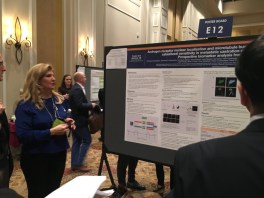
 Dr. Josephine Kang, a radiation oncologist at WCM/NYP, presented a poster on Stereotactic Body Radiotherapy (SBRT), which is an emerging treatment modality with excellent control rates for low- and intermediate-risk prostate cancer. The role of SBRT for high-risk prostate cancer has not been studied as closely, but this trial showed encouraging results for those with high-risk disease. These results are very encouraging, as the treatment can be completed in 5 treatments. Additionally, this data longitudinally followed men treated with this modality for 7 years, and it appears to be a safe and effective treatment for high-risk prostate carcinoma. SBRT may be a good treatment alternative particularly for patients unable to undergo hormonal therapy (androgen receptor therapy/ADT) or unwilling to receive standard 8-9 week radiation therapy. More research is ongoing. Learn more about our open clinical trial using this modality. Another study will soon be opening.
In the oral abstract session, data was presented from a cooperative group trial that the older chemotherapy drug mitoxantrone should not be used immediately following surgery. Assays from biopsy material can separate different classes of prostate cancer with different risk for inferior outcomes. Blood biomarkers utilizing circulating tumor cells appear to be prognostic and potentially predictive of response to certain drugs. We are currently participating in a study to validate this data across multiple institutions and technology platforms.
In the keynote lecture, Dr. Charles Drake who recently joined the NYP family at Columbia discussed the current status and future directions of immunotherapy for prostate cancer.
Stay tuned for additional updates throughout the symposium!
 With winter upon us, it is important for cancer patients to be prepared in the case of severe weather. During severe weather, such as a blizzard, it may be difficult to get to Weill Cornell Medicine. All of our physician practices have coverage 24 hours a day, 7 days a week, so if you have any urgent questions or concerns, please call the regular number and you will be able to reach the on-call physician.
 What's New in GU?