
 The 2017 European Society for Medical Oncology (ESMO) annual meeting has officially kicked off and our team has joined approximately 25,000 cancer researchers from around the world to present and discuss the latest cancer research.
 We’ve outlined some key highlights from the first day of the conference below.
For men with newly diagnosed “hormone sensitive” high risk / advanced prostate cancer, several recent studies have changed the standard of care. Data from the CHAARTED, STAMPEDE, and LATITUDE studies that investigated the addition of docetaxel or abiraterone and low dose prednisone to standard androgen deprivation therapy (ADT) for men with advanced prostate cancer has led to significantly longer and better lives. Updates to this data were presented at ESMO 2017.
The STAMPEDE study included an overlapping period where some men were randomized to ADT + docetaxel chemotherapy and others were randomized to ADT + abiraterone/prednisone. It was comforting to know that whether men received either chemotherapy with docetaxel for 6 cycles or abiraterone and prednisone continuously for at least 2 years that they lived significantly longer compared to men receiving the old standard of ADT alone.
The interesting comparison presented at ESMO 2017 was that men who took abiraterone had longer time to cancer progression (mostly assessed by rising PSA). There were similar overall survival outcomes with either initial treatment strategy. As expected, the types of side effects were different depending upon the type of treatment, but severe toxicity was equally common with either type of treatment.
For the first time, “patient reported outcomes” assessing symptoms and quality of life on the LATITUDE study (including men with high-risk metastatic disease treated with ADT + abiraterone/prednisone or ADT + placebos) were presented. In addition to living significantly longer and having major delays in cancer growth, men taking ADT + abiraterone/prednisone had better pain control and were less likely to have reductions in quality of life, particularly after the initial 4 months on treatment.
Prostate-specific membrane antigen (PSMA) is a protein that is on the cell surface of most prostate cancers and can be used as a treatment target since it is not present many other places in the body. At Weill Cornell Medicine and NewYork-Presbyterian, we have been targeting this protein with radioactive particles for more than a decade. Other institutions have also more recently begun using this approach. Over the past several years, there have been many patients receiving this type of therapy in Europe who may have benefitted from this treatment, but no real prospective clinical trials have been performed. Australian researchers presented data at ESMO in which they enrolled and treated 30 men whose tumors “lit up” on PSMA-PET scans with 177Lu-PSMA-617 in a clinical trial. Patients received up to 4 cycles of therapy. Most patients experienced a significant decrease in PSA, some had tumors shrink on scans, and severe side effects were limited.
We have previously published on the (initially) surprisingly high frequency of inherited “germline” alterations in men with advanced prostate cancer. A Spanish group performed a prospective study of 419 men and found that about 9% had alterations in genes that affect the body’s ability to repair damaged DNA. Among the 6.2% with the most common alterations – BRCA2, ATM, and BRCA1 — overall survival was not significantly shorter compared to men without these genetic mutations. However, when examining just the most common BRCA2 gene, men did not live as long. Whether or not these inherited DNA alterations were present, men could respond to approved therapeutic agents, so if clinical trials are not available men should be encouraged to take standard hormonal or chemotherapy.
 Babak B. Navi, MD, MS
 At the
 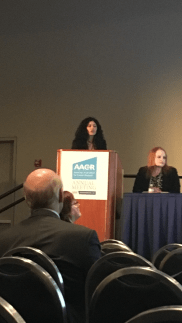 Loredana Puca, PhD, a postdoctoral associate mentored by Drs. Beltran and Rubin, highlighted the similarities in the microscopic anatomy of the cells and tissues (also referred to as the histology) between the organoids and the original biopsy tissue at the 2017 AACR meeting. Additionally, she presented results showing how the tumor’s DNA (also referred to as the genomics), as well as way the cells encode RNA to create proteins (also referred to as transcriptomics) – both of which are integral to the tumor’s ability to grow and mutate – are similar between organoids and biopsy. This sets the stage to utilize organoids for diagnostic and treatment testing in the hopes that the results will be more analogous to human tumors than traditional cell-line work.
 What's New in GU?