
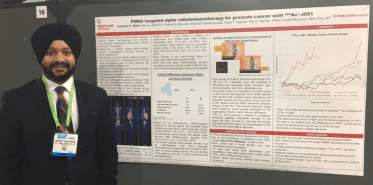
At the 2017 Annual Meeting for the Annual Association for Cancer Research (AACR), we presented research highlighting how we’re targeting PSMA – a marker on the surface of most prostate cancer cells – with radioimmunotherapy to kill cancer cells.
Radioimmunotherapy involves attaching radioactive particles to targeted immunotherapies that go directly to the cancer cells. The monoclonal antibody we use is called J591 and will bind only to PSMA. In this research, we attached the radioactive isotope actinium-225 (225Ac) to J591. We have used J591 linked with lutetium 177 (177Lu) and yttrium 90 (90Y) to treat patients in many clinical trials in the past. We believe that since 225Ac is an alpha particle emitter with much greater energy released that each individual antibody will lead to more tumor cell death. In our experimental models presented at the 2017 AACR meeting, 225Ac-J591 was not significantly more toxic than control (similar to placebo) in mice without tumors. When we treated mice with prostate cancer tumors, there was significant tumor killing following a single injection of 225Ac-J591.
Given our long history of administering radiolabeled J591 to hundreds of men in different clinical trials, we have plans to launch a phase I dose-escalation clinical trial (to determine safe doses and later look at tumor response) later this year. We and others are quite enthusiastic about this approach.
 At the
 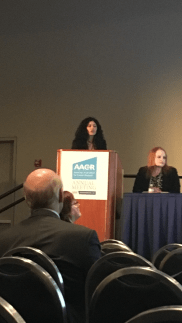 Loredana Puca, PhD, a postdoctoral associate mentored by Drs. Beltran and Rubin, highlighted the similarities in the microscopic anatomy of the cells and tissues (also referred to as the histology) between the organoids and the original biopsy tissue at the 2017 AACR meeting. Additionally, she presented results showing how the tumor’s DNA (also referred to as the genomics), as well as way the cells encode RNA to create proteins (also referred to as transcriptomics) – both of which are integral to the tumor’s ability to grow and mutate – are similar between organoids and biopsy. This sets the stage to utilize organoids for diagnostic and treatment testing in the hopes that the results will be more analogous to human tumors than traditional cell-line work.
 April brings more than just showers – the month kicks off with a very important cancer research conference. Tomorrow we are headed to Washington, DC for the American Association for Cancer Research (AACR) annual meeting held April 1-5, 2017.
 What's New in GU?