
 The third day of the 2017 Genitourinary Cancers Symposium started with a Best of Journals session on renal cell carcinoma (the most common form of kidney cancer) and the early poster sessions focused on renal cell, testicular, penile, and urethral cancers.
The first major morning session was focused on “novel targets and controversies in advanced testicular cancer.” Experts in the field first discussed actionable targets in testicular tumors, also referred to as germ cell tumors. This session also addressed a debate regarding treatment intensification in the subset of patients with “poor prognosis” – or germ cell tumors whose blood tumor markers do not decline optimally after initial chemotherapy. This subject remains controversial, but fortunately only affects a small number of patients, as in the current treatment era, after initial chemotherapy treatment, approximately 95% of all patients diagnosed with testicular cancer will be cured.
 The Keynote Lecture on renal cell carcinoma was delivered by Dr. Marston Linehan from the National Cancer Institute. He discussed the current state-of-the-art treatment which is based upon decades of research largely led by him on the genetic basis of renal cell carcinoma (RCC). Several of his discoveries about the genomics and biology of RCC have led to the current wealth of drugs available to treat this disease. One such discovery was the importance of the von Hippel Lindau gene in patients with familial cancer syndromes that also affects tumor genomics in most patients with clear cell RCC. This discovery led to investigation in targeting the VEGF pathway which is the backbone of most currently approved drugs.
The session on the diagnosis and treatment of local renal cancer (confined to the kidney) started with a presentation on the role of active surveillance or watchful observation in small renal tumors, and was followed by discussions on imaging and biopsy of renal masses. A talk about the use of ablation in small renal tumors was followed by an abstract presentation on a registry of active surveillance of patients with small renal masses. In summary, experts in the field discussed strategies and data behind the options of imaging and/or biopsy followed by either close surveillance or minimally invasive treatment strategies for patients with small renal masses.
The oral abstract scientific presentation session featured a presentation that followed up on the morning theme of small renal masses, also discussing surveillance, imaging, and circulating biomarkers. The Mayo Clinic group highlighted the success of treating carefully selected healthy patients with cryoablation in an expert center. A novel computer-assisted technique appears to be useful in assessing response to therapy compared to standard radiology assessment. A collaborative group led by Drs. Pal and Choueiri presented results of a large group of patients who had assessment of circulating tumor DNA (cfDNA) with a commercial platform prior to first-line or subsequent lines of treatment for metastatic disease. Additionally, an Italian group presented an abstract on changes in tumor burden and prognostic classification when patients with metastatic RCC utilize an active surveillance strategy rather than take medications or undergo a local procedure. This is important to realize that for carefully selected patients, just because there are metastatic (spread) tumors on scans, immediate treatment is not always necessary. Sometimes these remain stable over long periods of time without treatment and this can be discussed with experienced clinicians.
 The final session of the conference reviewed the opportunities and challenges in systemic therapy for advanced kidney (renal) cancer. Imaging techniques to optimally evaluate one’s response to targeted therapies was discussed, highlighting examples of successful treatment with very little change in tumor measurements by traditional techniques. For example, it’s possible for a tumor to appear the same size after treatment by standard measurement, but it can be 95% necrotic (dead) tissue and in this scenario, the patient feels better and may live longer. This would be classified as non-response (or stable disease). Unfortunately, for patients with larger or more invasive tumors, many patients are not cured with surgery alone despite normal scans elsewhere in the body. Dr. Karam reviewed the results of recently presented trials utilizing targeted therapy following surgery. While these are not quite ready for primetime, the medical community is currently awaiting the results of other studies well as current studies utilizing immune checkpoint inhibitors in combination with surgery. Drs. Vaishampayan and Jonasch discussed the multiple different treatment options available to physicians and patients with advanced RCC. Physicians were reminded to consider referral to a highly experienced center for high-dose interleukin (IL)-2, a treatment which offers long-term disease-free survival off therapy in a selected subset of patients with advanced kidney cancer. Current studies are ongoing to assess different drug combinations, as well as novel agents. The last presentation of the conference was led by Dr. Powles who presented a late-breaking abstract on the randomized phase II study of atezolizumab with or without bevacizumab versus sunitinib in patients with advanced previously untreated metastatic RCC. While not definitive, the results were intriguing and support the continuing phase III study assessing the use of the combination of atezolizumanb and bevacizumab. There are multiple new studies looking at combinations of drugs and we encourage patients interested in this type of treatment to look for sites that are enrolling.
Overall, the conference was a great opportunity for both academic and community physicians from all different specialties (including medical oncology, urology, radiation oncology, radiology, and pathology) to mix with and learn from each other. We look forward to participating next February in San Francisco for the 2018 Genitourinary Cancers Symposium.
 Following an initial “Best of Journals” session on prostate cancer, Day 2 of the
  The 2017 Genitourinary (GU) Cancer Symposium kicked off on February 16th in Orlando, Florida, bringing together more than 3,000 attendees from all over the world. At this annual conference, clinicians from a wide range of disciplines treating people with prostate cancer, kidney cancer, bladder cancer, and testicular cancer come together to hear from experts on the latest scientific discoveries and how they impact clinical care for patients.
 Team member Dr. Bishoy Faltas was selected by the conference to be a “Featured Voice” on Twitter, so be sure to follow him (
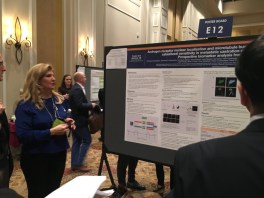 Dr. Evi Giannakakou explains to a crowd of physician-scientists results from our TAXYNERGY clinical trial showing additional evidence of using cancer cells circulating in the blood, also referred to as circulating tumor cells or CTCs, as a primary biomarker for chemotherapy response. This research validated prior work regarding the mechanism of action of chemotherapy in prostate cancer and demonstrates that using a simple blood draw, within one week of first chemotherapy treatment, we’re able to determine whether men with metastatic prostate cancer have a higher chance of responding. In the future, this might spare men from additional treatment (with associated side effects) with a drug that has a lower chance of working. For additional background information on this research,
  Dr. Josephine Kang, a radiation oncologist at WCM/NYP, presented a poster on
  What's New in GU?