
Radionuclides, also known as radioisotopes, are particles that emit energy. The different particles they emit vary and some types emit damaging radiation (also called ionizing particles). This is a good thing when we’re using radiation as a way to kill cancer cells. The two main categories of radiation particles used to kill cancer cells are alpha and beta particles.
Several radioisotopes – using both alpha and beta particles — have been approved by the Food and Drug Administration (FDA) for clinical use in cancer treatment. Historically, bone-seeking radioisotopes were used for patients with painful tumors in the bone. For example, Strontium-89 (Metastron) and samarium-153 (Quadramet) are beta-emitters that are taken up like calcium into bone and were approved to decrease pain. More recently, the alpha-emitting agent radium-223 (Xofigo) was approved for men with metastatic castration-resistant disease that has spread to the bone. However, unlike the previous beta-emitting agents, radium-223 was FDA-approved because it leads to longer overall survival rather than just symptom relief. Radium-223 is an alpha particle that mimics calcium and is delivered and taken up by the bone cells. This generally occurs near tumor cells, and while we don’t know the exact mechanism of action, we suspect that in addition to being in close proximity to some tumor cells, this creates a less hospitable environment for the tumor cells that have spread to the bone.
Additionally, we can now utilize different targeting agents to take radionuclides directly to the tumor cells. Radioimmunotherapy or radioligand therapy involves the practice of attaching a radioactive isotope to a cancer-targeting antibody or small molecule that binds only to a specific cancer-related molecule on a tumor cell. This is similar to a “lock and key” scenario, where the antibody or molecule resembles the key that will only recognize a very specific lock (the cancer-related molecule).
As it turns out, essentially all prostate cancer cells have a specific “lock” called prostate-specific membrane antigen (PSMA). This lock sits on the surface of each prostate cancer cell. We have engineered very specific monoclonal antibodies and molecules that will bind only to PSMA, leading to the opportunity for “molecularly targeted” (radio-)therapy.
In terms of attaching the radioactive isotopes, we can use both alpha and beta particles depending on the location and size of the tumor.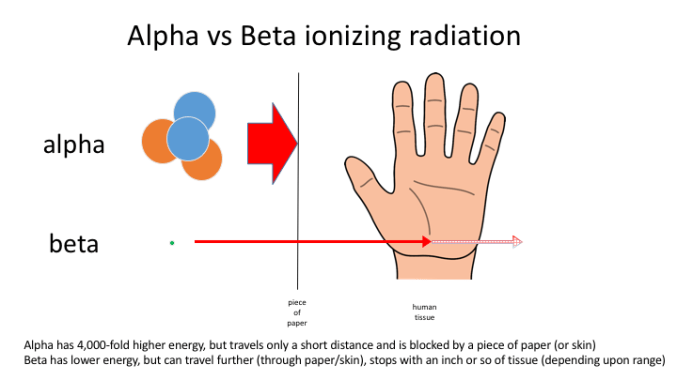 Alpha particles have the advantage of a very high amount of energy and a short path length. The amount of energy is high enough so that only a small number (1-10) of alpha particles lead to lethal damage to cells. An advantage of the short path length is that only the cells in close proximity to the alpha particle are destroyed, sparing other healthy and normal tissues. However, because of the short path length travelled, the alpha particle needs to be delivered into or right next to the tumor cell. In fact, even a piece of paper (or skin) is enough to block an alpha particle. Other alpha particles are being developed to be delivered as lethal payloads when attached to carrier molecules. One of these, actinium-225 (225Ac) is an alpha-emitting radionuclide that emits 4 alpha particles. In humans the 225Ac particle has been used as part of a compound linked to an antibody to treat leukemia and it also has been linked to a PSMA-recognizing peptide to treat men with late-stage prostate cancer with initial examples published last year.
Beta particles emit a lower energy, but can travel further distances. Because of their lower energy levels, more particles are required to cause lethal damage to cells.
This video provides a great overview of the process:
Additional research is needed to decipher the best radionuclides to use for which diseases in which clinical situations. We at Weill Cornell Medicine and NewYork-Presbyterian Hospital will have both alpha and beta radionuclides linked to PSMA compounds available in the clinic this year, initially with a clinical trial using 177Lu-PSMA-617, to be followed by 225Ac-J591, then the combination of 177Lu-J591 and 177Lu-PSMA-617.
 April brings more than just showers – the month kicks off with a very important cancer research conference. Tomorrow we are headed to Washington, DC for the American Association for Cancer Research (AACR) annual meeting held April 1-5, 2017.
 What's New in GU?