
“Moonshots” and More: How We’re Developing Personal Cancer “Cures” through Precision Medicine

In President Barack Obama’s final State of the Union address, he emphasized the “moonshot” need to cure cancer. At Weill Cornell Medicine and NewYork-Presbyterian Hospital, we are actively working towards that goal.
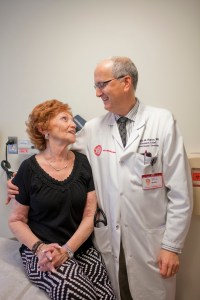
420_Dr. David Nanus with patient Irene Price 8 x 12
Irene Price and Dr. David Nanus, Chief, Hematology and Medical Oncology at Weill Cornell Medicine

Through our use of gene sequencing and precision medicine, we are transforming the way cancer is characterized and treated. Using a multidisciplinary approach and the EXaCT-1 test, here at the Weill Cornell Genitourinary (GU) Oncology Program, we are able to sequence the genes of advanced stage cancer patients. We can then narrowly tailor personalized treatment regimens based on the genetic makeup of a patient’s tumor which indicates whether a cancer is likely to respond to a particular treatment therapy.

Irene Price came to Dr. David Nanus, Chief of the Division of Hematology and Medical Oncology, with metastatic bladder cancer, and had more than 20,000 genes sequenced with the EXaCT-1 test. Dr. Nanus and his colleagues determined that the reason she wasn’t responding to prior treatment rested in a specific genetic mutation within her tumor. As a result, the team was able to prescribe a personalized treatment regimen – one more often used in the treatment of breast cancer.

The results were life changing. It caused her cancer to completely disappear. According to Price, “I’ve had college graduations that I wouldn’t have had, weddings that I wouldn’t have had, and the birth of great grandchildren that I wouldn’t have had.”

Learn more about our personalized approach to cancer care in a two-part series on NY1:

Part 1: “Gene Sequencing Effort Helps Pinpoint Cancer Treatments”

Part 2: “Tailored Cancer Treatments Fit Doctors’ New Approach”


To make an appointment with one of our clinicians, please call 646-962-2072.

Second-Line Treatments for Metastatic Kidney Cancer

Metastatic renal cell carcinoma (RCC) has traditionally been treated with the second-line chemotherapeutic agent everolimus, but two other drugs have been newly identified as better options that can give months or even years of life to patients with metastatic RCC. Two studies led by Dr. Robert J. Motzer of Memorial Sloan Kettering Cancer Center have recently shown that nivolumab and cabozantinib each improve survival of patients compared to those receiving the traditional everolimus treatment. Nivolumab in particular shows great promise, with 25% of patients responding to the drug versus 5% with everolimus, and a median survival of 26 months compared to 19.6 for everolimus- such a dramatic difference that the study was stopped early to allow the patients on everolimus to switch to nivolumab.
Nivolumab belongs to a class of cancer drugs called immune checkpoint inhibitors that are designed to turn the patient’s immune system against the cancer cells. Normally, the immune system is able to recognize cells like cancer cells that are growing abnormally. The immune system is then able to send a signal to the cancer cells to self-destruct, blocking the progression of the cancer. As cancers progress, many develop ways of avoiding being spotted by the immune system, preventing the patient’s body from fighting off the cancer. Immune checkpoint inhibitors like nivolumab unmask the cancer cells and enable the immune system fight back again. This is the first time an immune checkpoint inhibitor has been shown to improve survival of patients with metastatic RCC and will likely result in the approval of nivolumab as a new second-line agent for treating this disease.
More information can be found at the New England Journal of Medicine or The New York Times.

Please join us for our 8th Annual Free Prostate Cancer Screening!

prostate screening flyer 2015-page-001