
FDA Approves New Immunotherapy for Bladder Cancer

Cancer LabFor the first time in more than 20 years, today the FDA granted approval to a new treatment for urothelial carcinoma, the most common form of bladder cancer.

Tecentriq, also known as atezolizumab, is an immune checkpoint blockade or inhibitor that selectively binds to cancer cells based on the presence of PD-L1, a protein on the tumor surface. This is the first PD-L1 inhibitor that has been approved by the FDA for any disease.

PD-L1 is more strongly expressed on certain types of tumors, including urothelial cancers arising from the bladder, renal pelvis, and ureters. PD-L1 prevents the body’s immune system from being able to recognize the cancer and attack it, but PD-L1 inhibitors help the body to “see” the cancer and use the immune system to fight it.

This treatment has shown promise for platinum-resistant metastatic urothelial carcinoma – an advanced cancer that does not respond to traditional chemotherapies and which so far has very few other effective therapies.

In the study that ultimately led to atezolizumab’s approval by the FDA, it was shown to be effective at helping unleash the power of the immune system to recognize and attack these tumor cells.

The patients who responded positively to this treatment can do well on it for a long time. This is sometimes referred to as having a “durable response.” Few side effects were seen with this drug and they were mild. Severe side effects were rare and tied to too much immune activity. These study results first led to the FDA granting atezolizumab priority review designation in March 2016 to put it on the fast track for full FDA approval.

Additionally, in this study the investigators identified a correlation between mutational load and response to the drug. This means that when there was a higher concentration of proteins that could be recognized by the body, there was more sensitivity to this immunotherapy.

At Weill Cornell Medicine, we have been involved in the development of several types of immunotherapy and are at the forefront of developing ways to better determine which patients are most likely to respond to treatment. We are conducting research on how mutations and the “mutational load” can lead to the formation of neoantigens and the impact these neoantigens have on immunotherapy response in order to identify the patients most likely to benefit from this therapy.

We’re very excited to be able to offer Tecentriq/atezolizumab to our patients and encourage you to inquire about whether it’s a good fit for you. Additionally, we continue our research with immunotherapy and monoclonal antibodies for patients with urothelial cancer. One open clinical trial is testing whether a single checkpoint inhibitor (targeted at PD-L1) or dual checkpoint inhibitor (targeted at both PD-L1 and CTLA4 – a protein on the T-cell) is more effective against tumors compared with chemotherapy.
Dying from Prostate Cancer: Lessons Learned from the PLCO Trial

Screening for any disease, including prostate cancer remains imperfect. One study, the Prostate, Lung, Colorectal, and Ovarian (PLCO) Cancer Screening Trial, was a National Cancer Institute (NCI) sponsored study that took place between 1993-2001. The goal of the trial was to investigate the impact cancer screening had on dying from these four common tumor types. There were 76,693 men evaluated in the prostate cancer portion of the study.

While some aspects of this randomized trial remain controversial, including the impact that screening had on dying from prostate cancer, it remains a rich prospective dataset for further analysis, as it is one of the largest longitudinal studies ever conducted of men with prostate cancer.

In the “intervention” arm of the PLCO Screening Trial in which men were randomized to be screened for prostate cancer with annual prostate specific antigen (PSA) blood tests and digital prostate exams, there was still an unfortunate set of men who died from prostate cancer. Because the goal of the trial was to determine the prostate cancer mortality differences between the two arms, an understanding of who died and how they died is extremely important.

In a study led by Weill Cornell Medicine’s Dr. Chris Barbieri, we examined how men died of prostate cancer. Dr. Sameer Mittal presented the results of the research at an oral podium presentation yesterday at the 2016 American Urological Association annual meeting, with full results simultaneously published in European Urology.

Of 38,340 men in the screening arm, 151 died of prostate cancer. After graphing their oncologic courses of diagnosis and treatment, we noted a few interesting trends. The most prominent were as follows:

  • More than 50% of the men who died (81 men) either were never screened before this test or had their first PSA test result that was positive. These men were older and had higher median PSA (13.7). It’s possible that if these men were actually screened and or screened earlier and treated, their deaths from prostate cancer could have been prevented.
  • A subgroup of men who died despite screening were young and had a low median PSA (2.0). Surprisingly, they died within approximately 1.5 years of diagnosis. To put this in perspective, we expect an average man diagnosed with metastatic prostate cancer to live for 5 years, so this is quite unusual. We know that some subsets of prostate cancer do not secrete high levels of PSA and this is an area that needs more research in order to prevent further deaths. We don’t know for sure if these men had neuroendocrine prostate cancer (NEPC), but their rapid disease course seems consistent with this aggressive prostate cancer sub-type.

Despite what some may believe, some men do die of prostate cancer. We continue to research why this is the case in order to prevent further death and suffering from this common disease. These study insights underscore the importance of developing diagnostic biomarkers to better detect aggressive prostate cancers and to best predict the way the cancer will respond to various treatments.

Partnering to Detect Prostate Cancer

By Scott Tagawa, M.D.

Prostate cancer comes in many forms. Some tumors, however anxiety producing, are slow-growing tumors and simply require monitoring. And then, there are aggressive tumors that need treatment as soon as possible. Some times these aggressive tumors even spread microscopically prior to surgery or radiation without us knowing. By finding better ways to detect the types of prostate cancers that need to be treated, and as early as possible, we increase our cure rates and the number of people we’re able to treat effectively, while simultaneously minimizing interventions for those who don’t need them.

So where do we begin when it comes to detecting these aggressive tumors? And differentiating them from their less-aggressive counterparts?

Molecular imaging holds many of these answers, particularly for prostate cancer, as it offers a non-invasive way to detect the presence of cancer and distinguish between aggressive and non-aggressive sub-types. At the Weill Cornell Genitourinary (GU) Oncology Program, we’ve had a longstanding expertise in using molecular imaging to better diagnose and treat cancer.

Slide1
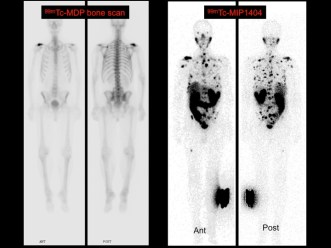
(Left) A traditional bone scan only shows one small possible site of metastases in the shoulder region of the bone, compared with the molecular imaging scan of the same patient (right) which indicates many metastases throughout the body.

Through our collaboration across multidisciplinary teams and with industry partners, at our academic medical center we have developed several imaging compounds, such as 99Tc-MIP 1404. This is a radiotracer used to more clearly “see” prostate cancer cells through their expression of the prostate-specific membrane antigen (PSMA). PSMA is a key biomarker in prostate cancer that is present on nearly all tumors. By using this target as a tracer, we can sometimes detect sites of tumors that were not evident on standard types of scans. In addition, the level of PSMA evident in prostate cancer cells can indicate whether the cancer is of a higher grade, more aggressive tumor within the prostate. Our patients were among the first to have received access to this technology. We’re currently leading a clinical trial that is pivotal to the FDA ultimately approving the widespread use of 99Tc-MIP 1404 to detect prostate cancer and help us ultimately determine the best course of treatment.

In part, due to this collaborative work, we were able to recruit the inventor of some of these imaging compounds, Dr. John Babich, to Weill Cornell Medicine in 2013. Collaboration is critical to scientific progress, and we are proud to be building on these accomplishments and forming new strategic partnerships in order to bring scientific discoveries to our patients more quickly than we would be able to if everyone worked in isolation.

It was recently announced that Weill Cornell Medicine has now formed a new research collaboration with Senior Scientific, LLC to investigate using non-radioactive magnetic nanoparticles to detect and diagnose prostate cancer. The combination of molecular nuclear medicine imaging with the magnetic relaxometry (MRX) technology may lead to improvements for many of the thousands of men facing the diagnosis of prostate cancer. We look forward to working with Dr. John Babich to bring MRX technology to our patients and will keep you apprised of research progress.