
Controlling Hot Flashes Related to Hormonal Therapy and Prostate Cancer

Androgen Deprivation Therapy (ADT), or hormonal therapy, is widely used in the treatment of metastatic and locally advanced prostate cancer, as most prostate cancer cells rely on testosterone to grow. Suppressing the testosterone hormone can cut off a fuel source for the prostate cancer. While ADT is a highly effective treatment and can be administered before, after or during radiation therapy, it is not without side effects. Some of the most common side effects of ADT are hot flashes and night sweats. Almost 80% of patients with prostate cancer experience hot flashes during or after treatment with ADT.

Hot flashes are sudden sensations of warmth, typically in the upper body in the face, neck, and chest areas. This sensation is often accompanied by sweating and flushing. Hot flashes can last seconds or as long as 20 minutes. They can also be associated with sleep disturbance, depressed mood, anxiety, and cognitive impairment. Hot flashes combined with sweating while sleeping are called night sweats. Night sweats because of ADT should not require patients to change their sheets daily due to drenching. Drenching is unlikely a side effect of ADT and should be discussed with care team members as this may signal that something else is going on.  Experiencing hot flashes and night sweats can decrease quality of life in men with prostate cancer and can lead to premature discontinuation of treatment, even if the therapy is working to keep the cancer at bay.

There are pharmaceutical and non-pharmaceutical interventions available to control hot flash symptoms and reduce the frequency of the sensations. These interventions include physical activities, behavioral therapies, device-based and pharmacologic (drug) interventions, as well as natural health products. It should be noted that some interventions, such as venlafaxine, which are a mainstay for treatment of hot flashes in women with postmenopausal hot flashes or hot flashes associated with breast cancer treatment have been proven to be ineffective for patients with prostate cancer. Some lifestyle and behavioral modifications that can help reduce the impact of hot flashes include avoiding caffeine, alcohol, and tobacco, as well as increasing exercise and physical activity.

In addition, the below methods for managing hot flashes were recently presented as part of new research shared at the American Society of Clinical Oncology (ASCO) annual meeting in June 2024.

  • MANCAN2: Results from this multicenter clinical trial evaluating cognitive behavioral therapy (CBT) to help patients with prostate cancer who are receiving ADT to manage hot flash and night sweat symptoms showed that a 4-week CBT program during ADT treatment reduced the impact of hot flashes and night sweats and resulting anxiety and depression for six weeks. The improvement, however, was not seen when looking further out to the 6-month mark. This study warrants further research to investigate the role of CBT in managing hot flashes and whether this benefit can be prolonged.
  • Alliance A222001: This randomized clinical trial evaluated the efficacy of Oxybutynin, a drug that blocks the action of the neurotransmitter acetylcholine, to improve hot flashes. Study authors concluded that twice-daily oxybutynin improved hot flash symptoms and reduced the frequency of hot flashes altogether compared to a placebo at the primary endpoint of 6 weeks. Oxybutynin, which was initially developed to treat urinary incontinence, did not have many severe side effects reported in the study. Since the drug has been used by many for urinary reasons, it is known that a common side effect is dry mouth, which occurred to a significant (moderately severe) degree in about 9% of patients taking oxybutynin and 8% of patients taking placebo. This drug is not FDA approved for the treatment of hot flashes.

Hot flashes were discussed widely at this year’s ASCO meeting, including in a session called, “Living Your Best Life on Treatment.” This important topic underscores the need to continue to discuss and develop interventions with the potential to improve quality of life for patients undergoing prostate cancer treatment. It is ultimately through new research and updated information that clinicians and patients with prostate cancer can work together to better manage, reduce or eliminate hot flashes.
Radiopharmaceutical Treatments for Metastatic Prostate Cancer

Radiopharmaceuticals (also sometimes called targeted radionuclide therapy or similar) are a type of medication that uses particles of radiation injected into the bloodstream to affect cancer. Radiopharmaceuticals are typically comprised of a radioactive particle, known as a radionuclide, sometimes combined with a targeting molecule that directs the radiation or points it towards a particular place. When injected into the body, this type of therapy is able to deliver radiation directly to the pointed target, limiting the exposure to the surrounding healthy tissue.

In prostate cancer, radiopharmaceuticals can be used in patients with metastatic prostate cancer that is not responding to hormonal therapy. While these treatments aren’t a cure, they are able to help these patients live longer with a better quality of life.

There are currently two radiopharmaceuticals approved by the U.S. Food and Drug Administration (FDA) for the treatment of metastatic prostate cancer. Both of these treatments are given via an intravenous (IV) injection or infusion, similar to other forms of cancer treatment.

Radium Ra 223 dichloride (Xofigo) was approved in 2013 and is used to target bone. In the setting of prostate cancer that has metastasized to the bones, patients live longer with this treatment.

Lutetium Lu 177 vipivotide tetraxetan (aka 177Lu-PSMA-617, Pluvicto) was approved in 2022 and delivers prostate-specific membrane antigen (PSMA) targeted radiation to prostate cancer cells that express PSMA (which encompasses the majority of prostate cancer). It can be used to treat PSMA-expressing cancer that has metastasized anywhere in the body, including the bones, internal organs, and lymph nodes.

New radiopharmaceutical treatment options are also being evaluated in clinical trials. A phase 1 clinical trial led by Dr. Scott Tagawa at Weill Cornell Medicine/NewYork-Presbyterian Hospital (WCM/NYP) evaluated the radiopharmaceutical 225AC-J591 in patients with advanced prostate cancer. Multiple additional studies of 225AC-J591 alone or in combination with other therapies are now underway at WCM to further assess the safety and efficacy of 225AC-J591.

In addition, multiple additional radiopharmaceuticals are in development, including drugs such as 67Cu-SAR-bisPSMA, 177Lu-rhPSMA-10.1, and TLX591. A full list of our open clinical trials in this area can be found here.

Patients with prostate cancer interested in radiopharmaceutical treatment should speak to their doctor to determine if this therapy may be a good option based on their individual situation. Patients will need to undergo two scans to determine if they are eligible to receive a radiopharmaceutical. One may be a bone scan to determine if the cancer has metastasized to the bones and the second may be a PSMA positron emission tomography (PET) scan to determine if the cancer cells have a high level of PSMA protein.  

To learn more about radiopharmaceuticals for metastatic prostate cancer, read this in-depth patient-friendly overview from Everyday Health featuring insights from Dr. Scott Tagawa, facts about radiopharmaceuticals, questions to ask your doctor about this treatment option, and more.

You can also learn more about the prostate clinical trials open at Weill Cornell Medicine/NewYork-Presbyterian Hospital here.

Bladder Cancer – From the Basics to State-of-the-Art

One of the many ways Weill Cornell Medicine and NewYork-Presbyterian provide supportive resources to the community is by offering physician-led presentations and Q&A sessions in the Myra Mahon Patient Resource Center.

Two weeks ago, Dr. Scott Tagawa, medical oncologist and Director of the Weill Cornell Medicine Genitourinary (GU) Oncology Program, presented to and educated people in the local community about bladder cancer. His presentation was titled, “Bladder Cancer: From the Basics to State-of-the-Art.” Following the presentation, all attendees were invited to ask Dr. Tagawa questions.

Key topics from Dr. Tagawa’s presentation included the most common risk factors for bladder cancer, different types of bladder cancer (also known as clinical phases), and corresponding treatment options, research, as well as the benefits of utilizing an individualized approach to treatment, also known as precision medicine.

Highlights from Dr. Tagawa’s presentation are outlined below.

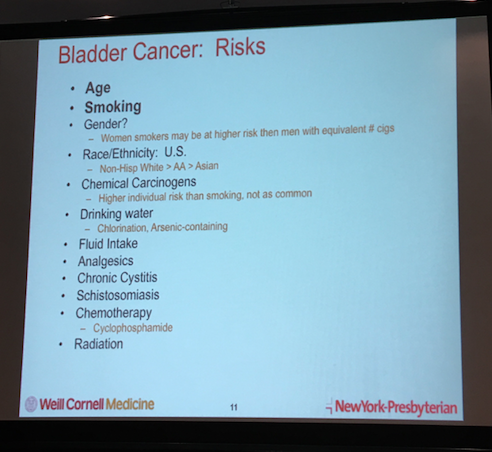
Bladder Cancer Risk FactorsScreen Shot 2017-12-14 at 9.22.30 AM

Dr. Tagawa noted that anyone can be diagnosed with bladder cancer, however, factors such as age and exposure to cigarette smoke may increase the risk of bladder cancer from developing. Most people who are diagnosed with bladder cancer are older in age. In fact, the average age at diagnosis is 73. In addition, bladder cancer is twice as common among Caucasians as African Americans.

Clinical Phases of Bladder Cancer and Corresponding Treatment Options

BladderCancer_5Dr. Tagawa highlighted the importance of using a uniform method for developing and testing biomarkers in bladder cancer, a disease with a high incidence of recurrence and expensive clinical surveillance. He also pointed out that most bladder cancers are of a type called transitional cell, affecting the same kinds of cells (transitional cells) that are usually the cancerous cells responsible for renal pelvis, ureter as well as kidney cancers. Dr. Tagawa described the four main phases of bladder cancer.

Pre-Cancer Diagnosis

The first phase is to assess symptoms in high-risk individuals, which defines those who are likely to develop bladder cancer. The most common symptom of bladder cancer is blood in the urine and testing to include assessment for the possibility of cancer would be beneficial for a high-risk population. Risk factors include, those who are aged 65 years or older, have used tobacco and has family history of cancer.

Often, the first test in the assessment of a patient with the symptom of blood in urine (or reddish urine) is a urinalysis, which is a test to assess for the presence of blood versus other elements that may appear like blood in the urine.  Other tests may include the assessment of other urine or blood factors, including assessment for infection. One test that is more specific for bladder cancer is a urine cytology, which looks at the urine under a microscope to detect abnormal appearing cells. If these cells are seen, a cancer diagnosis may be made, as the bladder has “shed” these cells into the urine. However, this test does not detect all cases of bladder cancer. Physicians may also want to perform blood tests or scans including, CT scan, MRI and ultrasounds.

“Superficial” Non-Muscle Invasive Disease

Non-muscle invasive disease means the cancer is confined to the inner lining of the bladder with no evidence that it has spread to another part of the pelvis or other organs. It used to be referred to as “superficial” bladder cancer, but this term is confusing since this stage of cancer often does invade into the first lining of the bladder. This type of bladder cancer comprises about 70% of all cases of newly-diagnosed bladder cancer. These patients are typically managed with resection (surgical removal of the cancerous parts of the bladder using a scope/camera), sometimes followed by intravesical therapy (usually immunotherapy with bacillus calmette-guerin), a process where the physician inserts a liquid drug directly into the bladder through a catheter. The drug can affect the cells lining the bladder without having major effects in other parts of the body.

Muscle Invasive Disease

In patients with muscle invasive disease, the cancer has spread into the muscle wall of the bladder. Those with this type of bladder cancer, which comprise of approximately 40% of all bladder cancer patients, are preferentially treated with systemic neoadjuvant chemotherapy followed by surgery to remove the bladder. Dr. Tagawa explained the different types of surgery patients may undergo if they are diagnosed with muscle invasive disease. The first is transurethral bladder tumor resection (TURBT), in which the surgeon removes the tumor using a tool with a small wire loop. Another form of surgery is a radical cystectomy, the removal of the whole bladder and possibly nearby tissues and organs. In addition, lymph nodes in the pelvis area are removed for both men and women, also known as a pelvic lymph node dissection. A selected subgroup of patients may have similar outcomes with a combination of initial TURBT surgery followed by chemotherapy and radiation.

Metastatic Disease

Patients with metastatic bladder cancer, accounting for approximately 15% of bladder cancer patients, have cancer that has extended through the bladder wall and invaded the pelvic and/or abdominal wall. Dr. Tagawa noted that while the other clinical states are treatable, if someone is going to pass away from bladder cancer, they would most likely be at the metastatic disease state. Dr. Tagawa highlighted that chemotherapy with platinum-based regimens remains the mainstay of first-line treatment for metastatic disease. He explained that if physicians combine platinum-based chemotherapy (e.g. cisplatin) with other treatments, patients will most likely benefit from positive clinical outcomes, resulting in tumor shrinkage and longer overall survival rates.

Systemic immunotherapy (administered into veins as opposed to only instillation in the bladder) is another treatment approach and one in which bladder cancer patients tend to have positive responses. The type of immunotherapy drugs given to patients with bladder cancer are known as immune checkpoint inhibitors, as they “release the brakes” on the immune system and allow immune cells to attack tumors. The first Food and Drug Administration (FDA)- approved immunotherapy drugs is tecentriq, also known as atezolizumab, which is an immune checkpoint inhibitor that selectively binds to cancer cells based on the presence of PD-L1, a protein on the tumor’s surface.  There are now five such drugs approved for bladder cancer – more than for any other cancer type.

Treatment Approaches in the Pipeline

Dr. Tagawa noted that we’ve come a long way in recent years with the most available treatment options than ever before for bladder cancer patients. He emphasized, though, that there is still room for improvement with the development of more treatments and additional treatment combinations to increase survival rates for patients. One of the ways physicians are able to do this is by utilizing precision medicine, treating each patient as an individual based on his or her own genetic makeup. For bladder cancer patients, physicians look at the different genes and whether the genetic mutations are within the tumor, or germline, to determine the best treatment options. Some of the most promising drugs for bladder cancer work best in the presence of certain altered genes. Another way clinicians are able to continue utilizing precision medicine is through clinical trials, which pave the way toward further scientific advances that could potentially find a cure for bladder cancer, in addition to other cancers. Weill Cornell Medicine and NewYork-Presbyterian offer many bladder cancer-specific trials that you can search for here.

Overall, Dr. Tagawa reinforced the benefit of working with a multidisciplinary team, which should include at least a surgeon, radiation oncologist and medical oncologist. He concluded his talk by emphasizing how clinical research has progressed over the years and what it has taught us – “we have seen translational therapy lead to real clinically relevant improvement for patients.”

Watch Dr. Tagawa’s full presentation below.