Living with One Kidney? 5 Things to Know

Dr. Molina and Dan R.
With many types of kidney cancer, surgical removal of the cancerous part of the kidney is part of treatment. This is also known as a “nephrectomy.” Depending on the size and location of your tumor, you may have had all or part of the kidney removed. People only need one kidney, but it’s very important to protect your remaining kidney function since the kidneys are responsible for filtering your blood and removing wastes from your body.

March is Kidney Cancer Awareness Month and the second Thursday in March is World Kidney Day. After you’ve had all or part of your kidney resected in order to remove a tumor, there are certain things to keep in mind in order to preserve your remaining kidney function. Here are five things you should know:

  1. Certain medications may need to be adjusted or avoided. Medications should be dosed according to your level of remaining kidney function. This is called “renal dosing” and pertains to all medications filtered by the kidneys (which covers a diverse group ranging from certain medications for cholesterol, heart disease, blood pressure, diabetes, infections and pain). A medical oncologist who specializes in kidney cancer should take this into account when prescribing medications, including dosing for cancer treatments. Some over-the-counter drugs are also “nephro-toxic” or harmful to the kidneys. These include non-steroidal anti-inflammatory drugs (NSAIDs), a type of pain medication that includes ibuprofen (Advil®), aspirin and naproxen (Aleve®).
  2. Speak up before imaging tests. Certain imaging tests that might be necessary to see what’s going on in your body and determine whether your cancer has spread, require the injection of contrast dyes. It’s critical to tell the imaging technician that you only have one kidney before undergoing these tests or any procedures. You should also hydrate before and after the test, and you may need to stop taking certain medications beforehand, such as metformin for diabetes. It’s important to discuss your specific situation with your healthcare team before you undergo any procedures.
  3. Drink up! Drinking plenty of water and staying hydrated is important on an ongoing basis, not just when undergoing imaging tests. Being hydrated helps your kidneys filter the wastes and toxins out of your blood so that they can leave your body as urine. Aim for your urine to be clear or pale yellow. Staying hydrated also helps prevent kidney stones.
  4. Watch the sugar and hold the salt. Diabetes and high blood pressure can damage the kidneys, so it’s important to monitor your sugar and salt/sodium intake. People with only one kidney should consume less than 2300mg sodium each day. This is approximately one teaspoon of salt. Those with diabetes should regularly check blood sugar levels. Additionally, maintaining a healthy weight and incorporating physical activity can help prevent developing type II diabetes.
  5. Know your numbers. There are certain blood and urine tests that you’ll want to monitor for changes in your level of kidney function over time. These include your estimated glomerular filtration rate (eGFR) which indicates how well your kidneys are filtering the wastes from your blood, the albumin to creatinine (A:C) ratio which indicates the level of protein in your urine, as well as tests for blood and infection. Work with your primary care physician to make sure you’re receiving these tests on an annual basis and you should see a nephrologist (kidney function specialist) if your eGFR is less than 30 milliliters per minute (ml/min) or if you have large amounts of blood or protein in the urine.

What are Cancer Neoantigens? The Link Between Neoantigens and Immunotherapy

By Bishoy Faltas, M.D.

Our immune system has evolved over time to enable us to fight infections. Our bodies need to differentiate between our own cells (self) and cells from bacteria and viruses (non-self) in order to mount an effective attack to eliminate the invaders. In order to do that, our immune system has learned to recognize fragments of foreign proteins, which carry a specific sequence that marks them as “targets” for the immune system. We call these antigens.

Cancer cells thrive because they hide from the immune system, but their disguise is not perfect. Cells typically become cancerous because of changes in their genetic makeup. These same changes can result in proteins that the immune system is able to recognize as foreign. These are called neoantigens, and refer to new cancer antigens that cue the immune system to attack the cancer and eliminate it.

neoantigen[2]
New sequencing technologies enable us to detect new cancer antigens unique to each patient.
The immune system just needs a little help to make this happen. To tip the balance in favor of the immune system, we now use drugs called immune checkpoint inhibitors. These unleash the power of the immune system to attack the tumor. A good way to think about it is as “releasing the brakes” off the immune response. This approach to treatment is very promising for bladder cancer, especially when other treatments have failed to stop the cancer from progressing or metastasizing to other organs.

To understand which patients are most likely to respond to these immune checkpoint inhibitors, we conducted a study examining the neoantigens in bladder cancer patients at Weill Cornell Medicine. Our analyses found many differences in the neoantigens between untreated tumors and advanced tumors that had previously been treated with chemotherapy from advanced chemotherapy-resistant bladder cancers. More details on our findings can be found here:

In the future, we are hoping to use neoantigens as biomarkers that tell us which patients are most likely to respond to specific immunotherapies. A form of precision medicine, this will help us to narrowly tailor our treatment approach to each patient.

Some of our current immunotherapy treatments for people with bladder cancers include:

Partnering to Detect Prostate Cancer

By Scott Tagawa, M.D.

Prostate cancer comes in many forms. Some tumors, however anxiety producing, are slow-growing tumors and simply require monitoring. And then, there are aggressive tumors that need treatment as soon as possible. Some times these aggressive tumors even spread microscopically prior to surgery or radiation without us knowing. By finding better ways to detect the types of prostate cancers that need to be treated, and as early as possible, we increase our cure rates and the number of people we’re able to treat effectively, while simultaneously minimizing interventions for those who don’t need them.

So where do we begin when it comes to detecting these aggressive tumors? And differentiating them from their less-aggressive counterparts?

Molecular imaging holds many of these answers, particularly for prostate cancer, as it offers a non-invasive way to detect the presence of cancer and distinguish between aggressive and non-aggressive sub-types. At the Weill Cornell Genitourinary (GU) Oncology Program, we’ve had a longstanding expertise in using molecular imaging to better diagnose and treat cancer.

Slide1
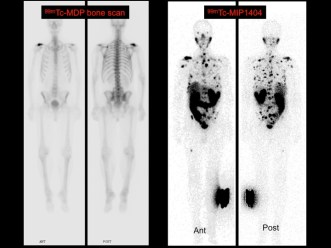
(Left) A traditional bone scan only shows one small possible site of metastases in the shoulder region of the bone, compared with the molecular imaging scan of the same patient (right) which indicates many metastases throughout the body.

Through our collaboration across multidisciplinary teams and with industry partners, at our academic medical center we have developed several imaging compounds, such as 99Tc-MIP 1404. This is a radiotracer used to more clearly “see” prostate cancer cells through their expression of the prostate-specific membrane antigen (PSMA). PSMA is a key biomarker in prostate cancer that is present on nearly all tumors. By using this target as a tracer, we can sometimes detect sites of tumors that were not evident on standard types of scans. In addition, the level of PSMA evident in prostate cancer cells can indicate whether the cancer is of a higher grade, more aggressive tumor within the prostate. Our patients were among the first to have received access to this technology. We’re currently leading a clinical trial that is pivotal to the FDA ultimately approving the widespread use of 99Tc-MIP 1404 to detect prostate cancer and help us ultimately determine the best course of treatment.

In part, due to this collaborative work, we were able to recruit the inventor of some of these imaging compounds, Dr. John Babich, to Weill Cornell Medicine in 2013. Collaboration is critical to scientific progress, and we are proud to be building on these accomplishments and forming new strategic partnerships in order to bring scientific discoveries to our patients more quickly than we would be able to if everyone worked in isolation.

It was recently announced that Weill Cornell Medicine has now formed a new research collaboration with Senior Scientific, LLC to investigate using non-radioactive magnetic nanoparticles to detect and diagnose prostate cancer. The combination of molecular nuclear medicine imaging with the magnetic relaxometry (MRX) technology may lead to improvements for many of the thousands of men facing the diagnosis of prostate cancer. We look forward to working with Dr. John Babich to bring MRX technology to our patients and will keep you apprised of research progress.