
 Immunotherapy, broadly defined as using the body’s own immune system to fight cancer, is one of the most exciting developments in cancer care. In oncology, for some patients using an immunotherapy treatment approach has resulted in some deep and prolonged responses.
The field of genitourinary (GU) oncology one was of the first sub-specialty areas to utilize immunotherapy and compared to many other tumor types, GU oncology has been using it for the longest amount of time — particularly for kidney (renal) and bladder cancers. There have been more recent advances across the board in immunotherapy, including the approval of atezolizumab by the FDA for bladder and urothelial cancers, marking the first new treatment for that tumor type in nearly three decades. Additionally, in select patients who have advanced urothelial cancer that has not responded to platinum-based chemotherapy, adding immunotherapy with pembrolizumab to the treatment regimen improved survival.
In the modern treatment era, prostate cancer was one of the first cancers to show a survival advantage with immunotherapy, specifically sipuleucel-T. Also known by the brand name Provenge, sipuleucel-T stimulates the immune system to seek out cancer cells and attack them. It represents the first therapeutic cancer vaccine in any cancer (treatment-focused as opposed to prevention-focused), and is FDA-approved for men with metastatic hormonal-resistant prostate cancer (mCRPC). Unfortunately, not all men respond to this treatment. At Weill Cornell Medicine and NewYork-Presbyterian, we are looking to improve responses to sipuleucel-T with our Newlink-sponsored study of sipuleucel-T followed by indoximod/placebo. In addition, since it is difficult to tell which patients are the best fit for this treatment and which ones are responding to sipuleucel-T, we continue collaborations with other researchers to work on developing blood tests to find biomarkers to help men in the future.
Additionally, recent data from the 2016 European Society of Medical Oncology (ESMO) annual meeting demonstrated promising results for using pembrolizumab (also called Keytruda) in metastatic hormonal resistant prostate cancer. This immunotherapy that works by inhibiting the PD-1 pathway and has been recently approved in other tumor types, such as melanoma and lung cancer. An initial study of the drug across different tumor types was highlighted at the ESMO meeting with significant responses in a proportion of men with prostate cancer whose cancers grew despite essentially all known therapies. In addition, a study influenced by and subsequently performed by different groups of WCM collaborators demonstrated that five men with progressive metastatic castration-resistant prostate cancer had major responses to this immune therapy, with PSA’s dropping by more than 99% and tumors greatly shrinking on scans. While all types of immunotherapy can lead to serious side effects, the treatment was generally very well-tolerated with minor side effects.
We are continuing the work to further define the subsets of men with advanced prostate cancer who can benefit from immunotherapy and we have a newly opened study of pembrolizumab for men with mCRPC. In this study, three groups of men will receive open-label (i.e. no placebo) pembrolizumab to test efficacy as measured by tumor shrinkage. We will also assess PSA changes and duration of tumor response, as well as biomarkers to help us determine in the future which men will receive the greatest benefit from this treatment.
Another promising immunotherapy-based prostate cancer treatment uses the monoclonal antibody (mAb) J591. J591 can recognize a protein antigen known as PSMA (also known as anti-prostate-specific membrane antigen) that is expressed on virtually all prostate cancer cells, and more heavily expressed in men with treatment-resistant metastatic forms of the disease. At the recent ESMO conference, we presented two clinical trials of J591 immunotherapy that are currently in progress here at Weill Cornell Medicine and NewYork-Presbyterian. One is for men with advanced prostate cancer and high (unfavorable) circulating tumor cell (CTC) count and the other delivers two doses of J591 prior to prostatectomy for men with intermediate and high risk prostate cancer. These trials are based upon the prior track record of this antibody in men with prostate cancer, including the fact that in initial pilot studies, men with advanced prostate cancer and a high number of CTCs had a decrease in tumor cell counts after J591. In addition, a prior study of J591 in combination with low-dose interkeukin-2 (IL-2) indicated that men with biochemically recurrent prostate cancer (rising PSA) did not develop metastatic disease as would have been expected without this intervention, and those with metastatic castration-resistant prostate cancer lived significantly longer than expected.
We also continue to utilize antibodies to deliver chemotherapy or radioactive particles to tumor cells with the intent of sparing normal cells. Three of these types of immunotherapy studies are currently enrolling for men with advanced prostate cancer, with others in development.
- IMMU-132: This compound consists of a drug attached to an antibody which recognizes Trop2, a target that is over-expressed on prostate cancer cells. The antibody carries SN38, the active ingredient in irinotecan, which has shown prior responses in solid tumors. The drug has shown promising activity in breast and bladder cancer and is now being studied in prostate cancer.
- Rovalpituzumab Tesirine “Rova-T” in Delta-Like Protein 3 (DLL3)-Expressing Advanced Solid Tumors: Our research has demonstrated that neuroendocrine prostate cancer (NEPC), one of the most aggressive and treatment-resistant prostate cancer subtypes, highly expresses DLL3. Rova-T uses an antibody to hone in on cells with DLL3 and take along a potent toxin to target those specific cells.
- 177Lu-J591 + ketoconazole: In this clinical trial, J591 is radiolabeled with 177Lutetium, (177Lu) in order to deliver the drug directly to the prostate cancer cells. It is given in combination with an oral hormonal therapy drug which both attacks prostate cancer and at the same time, increases expression of PSMA, which is recognized by J591, leading to more targeting of the otherwise invisible tumor cells.
 For the 7th year in a row, we are proud to participate in a month-long campaign to raise awareness and funds for men’s health issues each November, also known as Movember.
 Today, more than 5 million “Mo Bros” and “Mo Sistas” from more than 20 countries around the world have collectively raised over $700 million dollars to fund 1,200 men’s health projects.
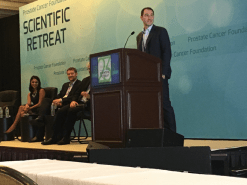 We at Weill Cornell Medicine have been fortunate to receive many of these grants over the past several years. Some of these recent Movember-PCF Challenge Grants have funded our research to study:
 Earlier this month, Dr. Himisha Beltran presented exciting new research results for those with metastatic prostate cancer at the European Society of Medical Oncology (ESMO)’s annual meeting in Copenhagen, Denmark. Cancer experts and patients from around the world came to the 2016 ESMO Congress to discuss the latest research and cutting-edge treatment options for people with cancer.
 What's New in GU?