
Movember 2016

Movember_Drs Nanus Beltran TagawaFor the 7th year in a row, we are proud to participate in a month-long campaign to raise awareness and funds for men’s health issues each November, also known as Movember.

The Movember Campaign helps men live happier, healthier and longer lives through investing in prostate cancer and testicular cancer screening and research, as well as mental health issues.

What’s Movember?

The initiative started in Australia in 2003, when two friends decided to try to bring back the moustache trend by growing out moustaches during the month of November. The following year, after they realized that this facial hair was quite the conversation-starter, they decided to channel that energy to raise money for prostate cancer research.

Over the next few years, both the moustaches and audiences grew. The fundraiser gained traction in Australia and New Zealand. In 2007, Movember officially launched globally with partnerships in the United States, Canada, United Kingdom and Spain, all with one cause in mind – to change the face of men’s health – literally and figuratively through increased awareness and funds.

movember_group_wgcToday, more than 5 million “Mo Bros” and “Mo Sistas” from more than 20 countries around the world have collectively raised over $700 million dollars to fund 1,200 men’s health projects.

How can you get involved?

A number of different ways!

  1. Join our Movember team. Our team, the Wild Weill Cornell Mos, is committed to raising awareness and funds for a cause that is near and dear to our hearts.
  2. Grow a moustache. How low can you grow? Make a statement! Commit to going razor-free and growing a moustache in solidarity this month. It’s a great conversation starter to encourage friends and family members to donate to Movember.
  3. Get moving! Take the Move challenge and increase your physical activity. You can “Fly for the Guys” by teaming up with us at two special Flywheel spin classes to benefit the Wild Weill Mos Movember Team. Never taken a spin class before? This is the perfect opportunity to try it out, and there will be many beginners. Mark your calendars and sign up today:
  1. Make a donation. Donate now to support our team.
  2. Get checked. Research shows that many men only go to the doctor when they’re sick. In honor of Movember, make an appointment to visit your doctor for an annual physical or encourage a loved one to visit the doctor. Many diseases can be prevented or at least treated when caught early, including cancer.
  3. Socialize and celebrate with us at Draught 55 on Thursday, December 1st. 100% of the proceeds from ticket sales will be matched and donated to Movember.

What type of research has been funded by Movember?

Movember is committed to funding research that will halve the number of deaths from prostate and testicular cancer by 2030. The Prostate Cancer Foundation (PCF), one of our partners in research, is partnered with Movember to distribute funds to the most worthy scientific teams and projects.
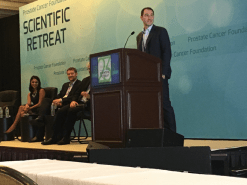
pcf-retreatWe at Weill Cornell Medicine have been fortunate to receive many of these grants over the past several years. Some of these recent Movember-PCF Challenge Grants have funded our research to study:

  • Blood tests that assess the tumor’s circulating DNA to predict reasons for treatment resistance
  • Circulating tumor cell (CTC) tests to predict which patients are more or less likely to respond to hormonal therapy or chemotherapy
  • Assessing the genome of “primary” tumors (i.e. the initial tumors in the prostate) compared to advanced, treatment resistant tumors
  • Evaluating inflammation in adipose (fat) tissue around the prostate, which is associated with tumor growth.

Learn more about the cutting-edge research funded by the PCF-Movember Challenge Grants in 2016, 2015 and 2014.

Promising Research Brings New Hope for Men with Aggressive Prostate Cancer

misha-beltra_esmo_img_2611Earlier this month, Dr. Himisha Beltran presented exciting new research results for those with metastatic prostate cancer at the European Society of Medical Oncology (ESMO)’s annual meeting in Copenhagen, Denmark. Cancer experts and patients from around the world came to the 2016 ESMO Congress to discuss the latest research and cutting-edge treatment options for people with cancer.

Dr. Beltran’s research presentation highlighted promising results from a clinical trial for men with aggressive prostate cancer. Aggressive prostate cancer sub-types represent approximately 25% of all prostate cancer cases, and neuroendocrine prostate cancer (NEPC) is considered to be the sub-type that is most resistant to currently-available treatments.

Dr. Beltran and the Weill Cornell Medicine (WCM) Genitourinary (GU) Oncology team led this multicenter, phase 2 clinical trial, which was based upon prior WCM work which identified aurora kinase A as a key target in NEPC. The trial enrolled sixty patients from across the United States. It was the first clinical trial to study a new, targeted treatment for men with NEPC. The drug used in this study, Alisertib, is an oral medication that is an Aurora Kinase A Inhibitor.

This clinical trial confirmed our hypothesis that different men’s tumors genetically expressed different levels of the targets for the drug, and as a result their response rates to this treatment varied. Those with the most optimal responses had cancers that genetically appeared to be most like NEPC in both biopsies and whole exome genomic sequencing of the tumor. As part of our Institute for Precision Medicine, we use the Exact-1 whole exome sequencing test to categorize more than 21,000 genes within the tumor. This is the most comprehensive way to determine where mutations and mechanisms for treatment resistance may exist in patients with advanced stage cancer and allows us to narrowly target different patient’s treatment regimens on the molecular level. In addition, some of the tumor biopsies were analyzed for gene expression (RNA) and organoids, which are tumor models that we are able to grow from the biopsy tissue, were developed.

In this clinical trial, we were able to learn a lot on the molecular level from the patients who had the most exceptional responses to Alisertib. Based on these results and establishing biomarkers to predict Alisertib response rates, future clinical trials could be much more targeted to include only the men whose tumors indicate that they are likely to respond to this therapy.

Additionally, there is great potential to learn much more about the tumor evolution and the biology of resistance. This clinical trial underscores the need to more narrowly focus on the sub-set of prostate cancer patients with NEPC, as there are few standard treatment options and limited clinical trials available for these men.

Thank you to all the men who enrolled in this clinical trial and helped further the field of research in the search for new cures for prostate cancer.

We’re always working to increase access to new promising treatments for NEPC and other aggressive forms of prostate cancer through clinical trials. To learn more about our open studies and to make an appointment with the Weill Cornell Genitourinary (GU) Oncology Program, call 646-962-2072.

6 Myths About Chemotherapy

Scott Tagawa, M.D.

dr-scott-tagawaChemotherapy often gets a bad rap due to the perception that the side effects of this cancer treatment are severe. What many people don’t know is chemotherapy refers to an umbrella category for different medications that work in a similar way. Just as different cancers are unique, chemotherapies are also unique and use different formula compounds. They also have brand and generic names.

I want to dispel some of the things I hear from patients about chemotherapy. Here are 6 of the most common chemo myths and misconceptions:

  1. It doesn’t work. False! While new cancer treatments are continuously being researched and developed, chemo remains the treatment gold standard for many types of cancers – including testicular cancer and metastatic prostate and bladder cancers – because it works. Through rigorous research, chemo has been shown to improve survival and increase the cure rates for many cancers, especially genitourinary (GU) cancers. Testicular cancer now has an approximately 99% cure rate which was not possible before chemotherapy. Additionally, chemotherapy increases the cure rates for bladder cancer and was more recently shown to have one of the most significant increases in survival compared to any other prior therapy for prostate cancer. Unfortunately, chemo doesn’t always work on every single type of cancer. In addition to the development of novel therapies, work is ongoing to help us select patients that will have more or less benefit from chemotherapy.
  2. It has significant side effects. This is partially true depending on what type of chemo you’re taking and what you perceive to be a negative side effect. Some chemotherapies cause hair loss as they attack the cancer cells, and this is one of the most “visible” side effects of treatment. What many people don’t realize, however, is that chemo can make patients feel better almost immediately because of its ability to control the cancer. For example, the first chemotherapy approved for prostate cancer (mitoxantrone) was approved because it made men feel better. The next generation chemotherapy (docetaxel) made men feel even better when compared to mitoxantrone. Moreover, the impact chemo has on quality of life is often short-term. Longer term, patients who undergo chemo report feeling better. A recently presented study showed that while overall quality of life was worse at an early time point during chemotherapy, men with metastatic prostate cancer had a superior quality of life a year later. This is likely due to the combination of better long-term cancer control and the fact that most chemo-related side effects are temporary. Additionally, while new treatment options, including immunotherapies, hold promise for many types of cancers, these do not work for everyone and are not without side effects either.
  3. It isn’t a one-size-fits-all approach. There are over 200 types of chemotherapies, each differing in function and specific use. For example, platinum-based chemotherapies are mainly used for bladder cancers while taxanes are used for prostate cancer.
  4. It isn’t a targeted treatment. Chemo is targeted in certain ways because it acts on specific receptors. For example, taxanes, which are one type of chemotherapy agent, have the ability to stop cells from growing by targeting structures inside the cell that help it multiply. In prostate cancer specifically, taxanes kill cancer cells by blocking the movement of specific receptors that promote cancer growth. At Weill Cornell Medicine and NewYork-Presbyterian, we are able to analyze the tumor for genomic mutations that can tell us whether you are more or less likely to respond to this type of treatment.
  5. It is painful. When you are receiving cycles of chemotherapy, it should not hurt. Some patients receive chemo through an IV (intravenously), while other chemos are given as oral medications that you can take at home. Most genitourinary cancer patients undergo treatment on an outpatient basis. If you experience discomfort, burning, or coolness speak to your nurse or another member of your cancer healthcare team.
  6. Chemo suppresses the immune system. I commonly hear this from patients as a reason to avoid chemo. While there is an infection risk associated with chemotherapy if blood counts are low, current data indicates that combining chemo with immunotherapy (either together or sequentially with one followed by the other) may be better than immunotherapy alone.

Oncologists and researchers are always looking for the best treatment options to bring cures to the greatest number of cancer patients. For many patients, chemo remains the best option at controlling the cancer growth and ultimately curing the cancer. For some patients, newer approaches such as immunotherapy or other biologic agents are more tailored to fighting their disease. At Weill Cornell Medicine, we continue to work on identifying which chemotherapy is best for the right tumor in the right patient at the right time, as well as developing strategies to deliver chemotherapy preferentially to tumors (sparing normal organs), and continuing to develop new immunotherapies and biologic-based approaches to treatment.