
Partnering to Detect Prostate Cancer

By Scott Tagawa, M.D.

Prostate cancer comes in many forms. Some tumors, however anxiety producing, are slow-growing tumors and simply require monitoring. And then, there are aggressive tumors that need treatment as soon as possible. Some times these aggressive tumors even spread microscopically prior to surgery or radiation without us knowing. By finding better ways to detect the types of prostate cancers that need to be treated, and as early as possible, we increase our cure rates and the number of people we’re able to treat effectively, while simultaneously minimizing interventions for those who don’t need them.

So where do we begin when it comes to detecting these aggressive tumors? And differentiating them from their less-aggressive counterparts?

Molecular imaging holds many of these answers, particularly for prostate cancer, as it offers a non-invasive way to detect the presence of cancer and distinguish between aggressive and non-aggressive sub-types. At the Weill Cornell Genitourinary (GU) Oncology Program, we’ve had a longstanding expertise in using molecular imaging to better diagnose and treat cancer.
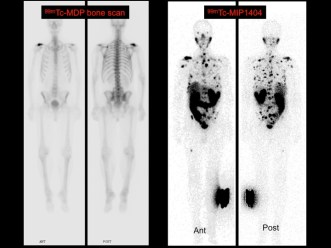
Slide1
(Left) A traditional bone scan only shows one small possible site of metastases in the shoulder region of the bone, compared with the molecular imaging scan of the same patient (right) which indicates many metastases throughout the body.

Through our collaboration across multidisciplinary teams and with industry partners, at our academic medical center we have developed several imaging compounds, such as 99Tc-MIP 1404. This is a radiotracer used to more clearly “see” prostate cancer cells through their expression of the prostate-specific membrane antigen (PSMA). PSMA is a key biomarker in prostate cancer that is present on nearly all tumors. By using this target as a tracer, we can sometimes detect sites of tumors that were not evident on standard types of scans. In addition, the level of PSMA evident in prostate cancer cells can indicate whether the cancer is of a higher grade, more aggressive tumor within the prostate. Our patients were among the first to have received access to this technology. We’re currently leading a clinical trial that is pivotal to the FDA ultimately approving the widespread use of 99Tc-MIP 1404 to detect prostate cancer and help us ultimately determine the best course of treatment.

In part, due to this collaborative work, we were able to recruit the inventor of some of these imaging compounds, Dr. John Babich, to Weill Cornell Medicine in 2013. Collaboration is critical to scientific progress, and we are proud to be building on these accomplishments and forming new strategic partnerships in order to bring scientific discoveries to our patients more quickly than we would be able to if everyone worked in isolation.

It was recently announced that Weill Cornell Medicine has now formed a new research collaboration with Senior Scientific, LLC to investigate using non-radioactive magnetic nanoparticles to detect and diagnose prostate cancer. The combination of molecular nuclear medicine imaging with the magnetic relaxometry (MRX) technology may lead to improvements for many of the thousands of men facing the diagnosis of prostate cancer. We look forward to working with Dr. John Babich to bring MRX technology to our patients and will keep you apprised of research progress.

Cancer: A Wolf in Sheep’s Clothing

Immunotherapy wolf in disguiseCancer cells can be pretty sneaky, altering their make-up or microenvironment to avoid detection by our body’s immune system. As a result, the immune system, which is designed to fight off “invaders,” can’t detect cancer as foreign and doesn’t have its guard up.

Earlier this month, NewYork-Presbyterian Hospital kicked off a new ad campaign highlighting how immunotherapy is working to change just that. Immunotherapy treatments are designed to help activate the immune system and kick it into high gear, helping it fight the very cancer it was previously unable to detect.

New scientific discoveries happening right here at Weill Cornell Medicine are making this possible. Our physician-scientists and researchers at the Meyer Cancer Center have found ways to help the immune system better recognize and destroy cancer cells by designing new immunotherapy drugs, cancer “vaccines,” and combination treatments. Through precision medicine and an individualized approach to cancer care, we are developing new ways to treat cancer more successfully than ever before. And, we’re accomplishing these results with less toxicity.

Over the past decade, the U.S. Food and Drug Administration (FDA) has approved several new immunotherapy drugs for advanced cancers. At the Weill Cornell Genitourinary (GU) Oncology Program, we have greatly contributed to the efforts to obtain FDA-approval for immunotherapies for GU cancers, including kidney cancer, bladder cancer, and prostate cancer.

For kidney cancer, we have been involved in many studies of drugs utilizing the immune system to fight cancer, including the phase 2 clinical trial that formed the basis for the large trial leading to the FDA approval and general availability of nivolumab (Opdivo) for renal cell carcinoma. Nivolumab is an immunotherapy that works by allowing the body’s existing immune system to kill tumors. Our team is now working on ways to improve this drug and other types of drugs.

For bladder and other urothelial cancers, we have been instrumental in the development of several antibodies that can be used with and without chemotherapy. Sacituzumab Govitecan (IMMU-132), an antibody-drug conjugate, has had remarkable preliminary activity. It works by leveraging the immune system and bringing a powerful drug directly to the interior of cancer cells in order to kill them from the inside out. We are continuing to use this drug as well as other immunotherapeutic agents to improve outcomes for patients with these types of cancer.

Based upon several scientific properties, prostate cancer is a good tumor type for immunotherapy, and in fact, the first therapeutic cancer vaccine (used to treat cancer rather than prevent cancer) was approved for prostate cancer. At Weill Cornell Medicine, exploiting the immune system remains a focus in fighting prostate cancer, with a number of ongoing and upcoming clinical trials. Weill Cornell Medicine continues to be a worldwide leader in work with monoclonal antibodies, which are proteins (like a “key”) that very specifically target cancer cells (with a specific “lock” that is not present on normal cells). In particular, our work with antibodies against prostate-specific membrane antigen (PSMA) has led to the development of several targeted therapies for prostate cancer. These antibodies can be linked to powerful radioactive particles or drugs that seek out prostate cancer cells (like a smart bomb). For men with prostate cancer whose PSAs rise despite hormonal therapy, we are leading a study of targeted radioimmunotherapy that aims to prevent metastatic disease. In addition, the antibody itself may be able to generate an immune response in prostate tumors and lead to clearance of circulating tumor cells. We are also working on developing vaccines for men with rising PSAs following surgery or radiation.

We continue to examine many promising, cutting-edge immunotherapies through our robust clinical trial program. Click the below links to learn more about eligibility and open clinical trials across the spectrum of GU cancers:

Open Immunotherapy-Based Clinical Trials

Prostate Cancer

Kidney, Bladder and Urothelial Cancers

To search our complete list of our open clinical trials, click here.

Dr. Scott Tagawa Presents at American Cancer Research Meeting

Dr. Tagawa
Dr. Tagawa

Weill Cornell’s Dr. Scott Tagawa presented four research posters at this year’s American Association for Cancer Research (AACR) annual meeting. Each of the presentations is summarized below. Click on the title to view the published abstracts.


Non-invasive measurement of prostate-specific membrane antigen (PSMA) expression with radiolabeled J591 imaging: a promising biomarker for PSMA-based radioimmunotherapy

J591 is a man-made monoclonal antibody that is able to recognize a protein antigen (PSMA) expressed on virtually all prostate cancer cells, and more so in men with treatment-resistant metastatic disease. When a tiny tag of radioactive material is attached to the J591 antibody, that specifically targets prostate cancer cells, and delivered systemically this is known as radioimmunotherapy. Dr. Tagawa has been conducting clinical trials of the precision radioimmunotherapeutic J591 to determine its ability to eradicate prostate cancer cells that have metastasized. In this poster presentation, Tagawa and colleagues performed a combined analysis of four clinical studies of this radioimmunotherapeutic that examined 130 patients with metastatic treatment-resistant prostate cancer. They found that the levels of PSMA expression—as determined by a non-invasive scan–can be used to indicate response to their radioimmunotherapy.

ERG induces taxane resistance in castration-resistant prostate cancer

Taxanes are a type of chemotherapy drug that are used to treat advanced prostate cancer; however, inevitably prostate cancer patients develop resistance to these chemotherapy drugs. In this poster, Tagawa et al demonstrate that a genetic abnormality (ERG positivity) found in half of all men with prostate cancer plays an active role in inducing resistance to taxane-based chemotherapeutics. Additionally they’ve determined that men with ERG positive tumors have upregulation of another protein (clusterin) that can cause resistance to taxane chemotherapeutics. This work dovetails nicely with Dr. Zoubeidi’s work (see above) and shows the potential to use a drug now in clinical trials (OGX-011) to enhance response to chemotherapy in men whose prostate cancer is positive for the ERG genetic aberration.

Using CTCs to interrogate mechanisms of taxane resistance in the prospective TAXYNERGY clinical trial in prostate cancer

This poster describes a prospective, randomized multi-site clinical trial that will enroll 100 men with treatment resistant prostate cancer and use advanced technology to capture and analyze cancer cells that are freely circulating in their bloodstreams. This trial will allow the researchers to look for early signs of treatment response or failure in individual cancer cells and examine the genetic and other molecular factors that indicate or lead to either a response or lack of response to chemotherapy. This is one of the few studies to utilize blood-based biomarkers in a prospective fashion. It is also a demonstration of cooperation between academic partners and the pharmaceutical industry—one that was facilitated by the Prostate Cancer Foundation.

Prostate circulating tumor cells metastasize to bone via E-selectin expressed on endothelia cells

This poster describes a molecular dance that prostate tumor cells exploit as they metastasize to bone. Understanding and characterizing the mechanisms that tumor cells use exit the bloodstream and to home to bone and set up shop should allow researchers to develop ways to interrupt the process and prevent circulating prostate cancer tumor cells from setting up cancerous shop in men’s bones.