
Hi-Tech Blood Biomarker Signals When a Strategic Switch in Chemotherapy Will Benefit Prostate Cancer Patients

For men with metastatic prostate cancer that grows despite hormonal therapy (also referred to as castration-resistant prostate cancer), chemotherapy has been a mainstay. The class of chemotherapy that has consistently proved to improve survival for men with advanced prostate cancer is called “taxanes.”

Taxanes target microtubules, which are structures in cells that are involved in cell division, as well as the trafficking of important proteins. In prostate cancer, one of the main ways taxane chemotherapy works to kill the cancer cells involves blocking the movement of the androgen receptor (AR) along the microtubule “tracks” towards the cell nucleus, a mechanism we discovered here at Weill Cornell Medicine.

There are two taxanes FDA-approved to treat prostate cancer, docetaxel (brand name: Taxotere) and cabazitazel (brand name: Jevtana). While the drugs are similar, men whose tumors have grown despite taking one drug often respond to the other. The challenge for oncologists has been pinpointing when exactly to switch treatments.

ScottTagawa_ASCO2016_TAXYNERGYDr. Scott Tagawa presented exciting results from a phase II clinical trial at the 2016 American Society for Clinical Oncology (ASCO) annual meeting demonstrating the power of this treatment switch, and when to make the switch.

This research came to be because we thought that we might be able to increase the number of men who respond to taxane chemotherapy with an early assessment and by changing the drug for those who have a sub-optimal response. Simply put, those with no response or only an initial minor response had their drug changed at a much earlier time point then standard practice. This resulted in a higher response rate for the patients in the study.

Top Boxes_Taxynergy
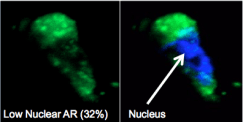
In the photos from a sub optimally responding patient, almost all of the androgen receptor (AR, labeled in green) is in the nucleus (indicated by the arrow which is overlayed in blue on the right), meaning that the taxane chemotherapy treatment was unable to block AR from moving to the nucleus and thus unable to kill the prostate cancer cells.

In addition, it’s very exciting that we can examine cancer cells from a simple blood test, a process also referred to as collecting circulating tumor cells or CTCs. This allows us to assess the ability of a drug to target the pathway in real time and to tell us whether there is a positive tumor response or resistance.

These circulating tumor cells provide an opportunity for real-time molecular analysis of taxane chemotherapy and at Weill Cornell Medicine we’ve pioneered a way to examine the AR pathway with a simple blood test.

To do this we use an extremely specialized technology that captures the very small fragments or rare circulating tumor cells on a “chip.” From this chip we are able to determine which cells are responding to treatment.
Bottom Boxes_Taxynergy
In real time, we can see taxane chemotherapy kept the (green) AR out of the (blue) nucleus area in cells from a responding patient. 

In cancer care, we are always trying to maximize treatment response rates by targeting the right cells at the right time. This promising precision medicine approach offers us one more tool to better personalize treatment and improve outcomes.

 

ASCO 2016: Updates in Advanced Prostate Cancer and Precision Medicine

Advances in therapeutics have led to improvements in both survival and quality of life for patients with cancer, including men with advanced prostate cancer. Simultaneously, a number of cutting-edge scientific advances have been made in the underlying biology of advanced prostate cancer. There is great potential and power in integrating these new therapeutics and biomarkers, which is often referred to precision medicine. While great advances have already been made in this area, many remain highly sophisticated and restricted to selected centers, such as Weill Cornell Medicine and NewYork-Presbyterian Hospital, while others still need validation in a larger number of patients. Ultimately, the goal is to be able to bring these technologies and treatments to cancer patients all around the country and the world.

MishaBeltran_ASCO16
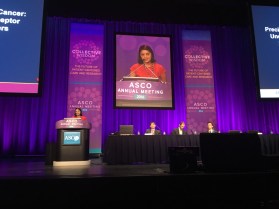
Dr. Misha Beltran speaks to a full house at the ASCO 2016 Annual Meeting in Chicago.

At the 2016 ASCO meeting, Dr. Himisha Beltran was the chair of a session entitled “Precision Medicine in Advanced Prostate Cancer: Understanding Genomics, Androgen Receptor Splice Variants, and Imaging Biomarkers.” This session intended to demystify some of the language and updates surrounding precision medicine.

Dr. Beltran spoke about important recent advances in tumor and patient genomics, such as the specific genetic alterations that we now know drive different types of tumors and play a role in the development of aggressive forms of the disease. The Cancer Genome Atlas (TCGA), a government-led initiative through the National Cancer Institute (NCI) has generated multi-dimensional maps for key genomic changes in 33 different types of cancer. It also provides a collaborative platform for physicians and researchers to search, download, and analyze data. Through the TCGA there have been critical discoveries regarding untreated primary prostate tumors with molecular classification of different subtypes that go beyond Gleason scores (the common way pathologists “grade” the aggressiveness of tumors).

Additionally, the first publication of the Stand Up to Cancer Prostate Cancer Dream Team demonstrated the genomic landscape of metastatic biopsies in the castration-resistant setting, which have differences compared to primary prostate tumors and fall into groups which may be targetable by certain therapies. Dr. Mark Rubin is the Weill Cornell Primary Investigator for the Stand Up to Cancer Dream Team. In addition, as follow up to Dr. Beltran’s initial 2011 publication, she detailed the results of Weill Cornell’s collaborative efforts leading to key discoveries in neuroendocrine and castration-resistant prostate cancer using tumor tissue as well as circulating tumor cell analysis.

Collaborator Dr. Gerhardt Attard presented data on utilizing DNA obtained from blood only, an emerging method of accessing the tumor’s genomic information in a non-invasive manner, which may decrease the need for a biopsy and allow for multiple samples to be assessed over time. One clinically relevant portion of his work, being done in collaboration with Drs. Beltran and Francesca DeMichelis, is ongoing through a Prostate Cancer Foundation – Movember Challenge Award grant. Together, we are leveraging our published genomic data on neuroendocrine and treatment-resistant prostate cancer with the circulating tumor DNA from blood technology to assess patients’ cancer status before, during, and after treatment.

In addition to improvements in tumor and blood-based biomarkers, imaging biomarkers are also being investigated. Dr. Michael Morris described standardizing the use of traditional scans to assess prostate cancer progression. In addition, there are a number of molecular imaging modalities that may demonstrate increased sensitivity in the detection of tumors as well as give insight into the biology of individual tumors, highlighted by prostate specific membrane imaging including the New York-based collaboration between Memorial Sloane Kettering Cancer Center and Weill Cornell Medicine investigators.

ASCO 2016 is Upon Us

Each year, more than 30,000 professionals from around the world come together to discuss groundbreaking research findings at the American Society for Clinical Oncology (ASCO) annual meeting.

This year’s meeting, in Chicago from June 3-7, will feature over 5,000 different abstracts. The Genitourinary (GU) Oncology team will be presenting recent prostate and kidney cancer clinical trial results and updates on using precision medicine to translate genomic information into treatments. Vice President Joe Biden will also be at ASCO to deliver remarks on the Cancer Moonshot Initiative to accelerate cancer research and improve patient care through increased collaboration.

Check out the schedule to see when we’ll be presenting, and be on the lookout for daily “What’s New in GU?” blog updates regarding these noteworthy topics and more:

  • The impact of a split-dose schedule using Lutetium 177, a targeted treatment that has been previously shown to be effective against metastatic prostate cancer
  • The effect of changing prostate cancer chemotherapies early on when one drug doesn’t seem to be working as effectively as it could be, and when to switch
  • How a blood test may be used to detect trace tumor cells in the body and what this reveals about the mechanism behind taxane chemotherapy treatment

ASCO 2016