
One of the many ways Weill Cornell Medicine and NewYork-Presbyterian provide supportive resources to the community is by offering physician-led presentations and Q&A sessions in the Myra Mahon Patient Resource Center.
Two weeks ago, Dr. Scott Tagawa, medical oncologist and Director of the Weill Cornell Medicine Genitourinary (GU) Oncology Program, presented to and educated people in the local community about bladder cancer. His presentation was titled, “Bladder Cancer: From the Basics to State-of-the-Art.” Following the presentation, all attendees were invited to ask Dr. Tagawa questions.
Key topics from Dr. Tagawa’s presentation included the most common risk factors for bladder cancer, different types of bladder cancer (also known as clinical phases), and corresponding treatment options, research, as well as the benefits of utilizing an individualized approach to treatment, also known as precision medicine.
Highlights from Dr. Tagawa’s presentation are outlined below.
Bladder Cancer Risk Factors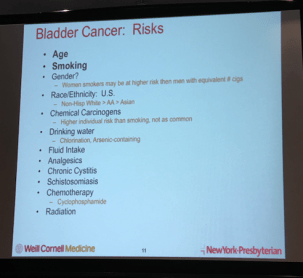
Dr. Tagawa noted that anyone can be diagnosed with bladder cancer, however, factors such as age and exposure to cigarette smoke may increase the risk of bladder cancer from developing. Most people who are diagnosed with bladder cancer are older in age. In fact, the average age at diagnosis is 73. In addition, bladder cancer is twice as common among Caucasians as African Americans.
Clinical Phases of Bladder Cancer and Corresponding Treatment Options
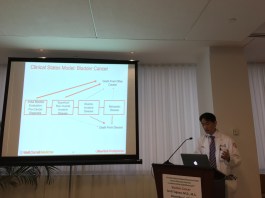 Dr. Tagawa highlighted the importance of using a uniform method for developing and testing biomarkers in bladder cancer, a disease with a high incidence of recurrence and expensive clinical surveillance. He also pointed out that most bladder cancers are of a type called transitional cell, affecting the same kinds of cells (transitional cells) that are usually the cancerous cells responsible for renal pelvis, ureter as well as kidney cancers. Dr. Tagawa described the four main phases of bladder cancer.
Pre-Cancer Diagnosis
The first phase is to assess symptoms in high-risk individuals, which defines those who are likely to develop bladder cancer. The most common symptom of bladder cancer is blood in the urine and testing to include assessment for the possibility of cancer would be beneficial for a high-risk population. Risk factors include, those who are aged 65 years or older, have used tobacco and has family history of cancer.
Often, the first test in the assessment of a patient with the symptom of blood in urine (or reddish urine) is a urinalysis, which is a test to assess for the presence of blood versus other elements that may appear like blood in the urine. Other tests may include the assessment of other urine or blood factors, including assessment for infection. One test that is more specific for bladder cancer is a urine cytology, which looks at the urine under a microscope to detect abnormal appearing cells. If these cells are seen, a cancer diagnosis may be made, as the bladder has “shed” these cells into the urine. However, this test does not detect all cases of bladder cancer. Physicians may also want to perform blood tests or scans including, CT scan, MRI and ultrasounds.
“Superficial” Non-Muscle Invasive Disease
Non-muscle invasive disease means the cancer is confined to the inner lining of the bladder with no evidence that it has spread to another part of the pelvis or other organs. It used to be referred to as “superficial” bladder cancer, but this term is confusing since this stage of cancer often does invade into the first lining of the bladder. This type of bladder cancer comprises about 70% of all cases of newly-diagnosed bladder cancer. These patients are typically managed with resection (surgical removal of the cancerous parts of the bladder using a scope/camera), sometimes followed by intravesical therapy (usually immunotherapy with bacillus calmette-guerin), a process where the physician inserts a liquid drug directly into the bladder through a catheter. The drug can affect the cells lining the bladder without having major effects in other parts of the body.
Muscle Invasive Disease
In patients with muscle invasive disease, the cancer has spread into the muscle wall of the bladder. Those with this type of bladder cancer, which comprise of approximately 40% of all bladder cancer patients, are preferentially treated with systemic neoadjuvant chemotherapy followed by surgery to remove the bladder. Dr. Tagawa explained the different types of surgery patients may undergo if they are diagnosed with muscle invasive disease. The first is transurethral bladder tumor resection (TURBT), in which the surgeon removes the tumor using a tool with a small wire loop. Another form of surgery is a radical cystectomy, the removal of the whole bladder and possibly nearby tissues and organs. In addition, lymph nodes in the pelvis area are removed for both men and women, also known as a pelvic lymph node dissection. A selected subgroup of patients may have similar outcomes with a combination of initial TURBT surgery followed by chemotherapy and radiation.
Metastatic Disease
Patients with metastatic bladder cancer, accounting for approximately 15% of bladder cancer patients, have cancer that has extended through the bladder wall and invaded the pelvic and/or abdominal wall. Dr. Tagawa noted that while the other clinical states are treatable, if someone is going to pass away from bladder cancer, they would most likely be at the metastatic disease state. Dr. Tagawa highlighted that chemotherapy with platinum-based regimens remains the mainstay of first-line treatment for metastatic disease. He explained that if physicians combine platinum-based chemotherapy (e.g. cisplatin) with other treatments, patients will most likely benefit from positive clinical outcomes, resulting in tumor shrinkage and longer overall survival rates.
Systemic immunotherapy (administered into veins as opposed to only instillation in the bladder) is another treatment approach and one in which bladder cancer patients tend to have positive responses. The type of immunotherapy drugs given to patients with bladder cancer are known as immune checkpoint inhibitors, as they “release the brakes” on the immune system and allow immune cells to attack tumors. The first Food and Drug Administration (FDA)- approved immunotherapy drugs is tecentriq, also known as atezolizumab, which is an immune checkpoint inhibitor that selectively binds to cancer cells based on the presence of PD-L1, a protein on the tumor’s surface. There are now five such drugs approved for bladder cancer – more than for any other cancer type.
Treatment Approaches in the Pipeline
Dr. Tagawa noted that we’ve come a long way in recent years with the most available treatment options than ever before for bladder cancer patients. He emphasized, though, that there is still room for improvement with the development of more treatments and additional treatment combinations to increase survival rates for patients. One of the ways physicians are able to do this is by utilizing precision medicine, treating each patient as an individual based on his or her own genetic makeup. For bladder cancer patients, physicians look at the different genes and whether the genetic mutations are within the tumor, or germline, to determine the best treatment options. Some of the most promising drugs for bladder cancer work best in the presence of certain altered genes. Another way clinicians are able to continue utilizing precision medicine is through clinical trials, which pave the way toward further scientific advances that could potentially find a cure for bladder cancer, in addition to other cancers. Weill Cornell Medicine and NewYork-Presbyterian offer many bladder cancer-specific trials that you can search for here.
Overall, Dr. Tagawa reinforced the benefit of working with a multidisciplinary team, which should include at least a surgeon, radiation oncologist and medical oncologist. He concluded his talk by emphasizing how clinical research has progressed over the years and what it has taught us – “we have seen translational therapy lead to real clinically relevant improvement for patients.”
Watch Dr. Tagawa’s full presentation below.
 Urothelial carcinoma is the most common type of bladder cancer, also affecting other parts of the urinary system. It is an aggressive disease and its treatment remains challenging for clinicians. Currently, each year there are nearly 80,000 new cases of urothelial cancer and approximately 16,000 deaths from the disease, according to the American Cancer Society. Unfortunately, there are limited therapeutic options for those with advanced urothelial carcinoma especially after the disease spreads to other distant organs (metastasis). Even with
  “It would be very difficult to conduct a randomized clinical trial testing surgery versus no surgery in those with urothelial carcinoma, so reviewing a large dataset retroactively is the next best thing,” says Dr. Bishoy Faltas, Assistant Professor and medical oncologist at Weill Cornell Medicine’s Genitourinary Oncology Program. “Our study shows that in well-selected patients with urothelial carcinoma with a reasonable life expectancy, resection of metastatic lesions is safe and associated with long-term survival and potential cures,” says Dr. Faltas.
 The second day of ESMO included the oral genitourinary (GU) oncology session that focused on renal cell (kidney) and urothelial (bladder) carcinoma.
 In the EORTC 30073 SURTIME trial, European investigators decided to try to assess whether tumors remained under control longer and patients lived longer if surgery was performed first or if patients initiated sunitinib for 3 cycles prior to cytoreductive nephrectomy. Because enrollment was slow, the study design was changed to assess the percent of patients that were free of tumor progression at 28 weeks. Ninety-nine patients were randomized to immediate versus delayed surgery, most with large kidney tumors and intermediate-risk cancer. Overall there was no difference in the percent with cancer progression at 28 weeks with either approach. With the caveat of a small study, there were trends for longer survival and less surgical complications in those with delayed surgery. While the amended study is not able to prove that delayed surgery is the better approach, it gives comfort for those physicians/patients that the choice to initiate medical therapy and then re-evaluate for surgery is acceptable. We await the results of the larger CARMENA study that is testing surgery followed by drug versus drug alone (with no surgery) to see if removal of the primary kidney tumor is necessary.
 The phase II portion of a phase I/II study testing the combination of lenvatinib + pembrolizumab. The initial (phase 1) portion of the study presented at ESMO 2016 determined the safe dose in patients with different types of tumors (mostly RCC). This year, new results were presented with 22 additional patients added to the 8 previously treated on the phase I portion. Overall, there was an impressive tumor response rate of 63%, with 83% significant tumor shrinkage in those patients treated in the 1st line setting. This combination is also being tested in a phase III study for patients with advanced RCC which will soon be opening at Weill Cornell Medicine and NewYork-Presbyterian.
 What's New in GU?