

Dr. Scott Tagawa Presents Results of PSMA Imaging for Radioimmunotherapy in CRPC at AACR

Dr. Tagawa
Dr. Tagawa

Weill Cornell’s Dr. Scott Tagawa presented updated results of PSMA imaging in 4 phase I and II clinical trials at the recent annual meeting of the American Association of for Cancer Research (AACR) in Washington, DC. The trials presented were performed at Weill-Cornell Medical College, New York Presbyterian Hospital and Memorial Sloan-Kettering Cancer Center. The trials investigated the antitumor activity and safety profile of the experimental drug ATL101. The 4 trials involved patients treated with ATL101 and demonstrated that PSMA imaging might be used to predict response to ATL101 radioimmunotherapy in metastatic castrate-resistant prostate cancer patients.

ATL101 is a new targeted radiotherapy experimental drug for treating prostate cancer. ATL101 combines the humanized J591 monoclonal antibody targeting prostate-specific membrane antigen (PSMA) plus the Lutetium-177 radioisotope, creating the first tumor-specific delivery system able to target radiation to radio-sensitive prostate cancer cells wherever they are in the body.

PSMA is the single most well-validated prostate cancer-specific cell membrane antigen known. It is present at high levels in 95% of prostate cancers, and it is rapidly internalized leading to accumulation of significant amounts of isotopes that can be linked to the J591 antibody. Humanized J591 monoclonal antibody has shown the ability, in several hundred patients studied to date, to exclusively target prostate cancer cells wherever they are in the body without targeting normal cells.

Lutetium-177 is a radioisotope that, once internalized into the cell, is irreversibly sequestered within the targeted tumor cell. It emits radiation over a millimetre range that is ideal for eradication of the small volume lesions commonly found in the bone marrow and lymph nodes of prostate cancer patients.

ATL101 is actively studied at Weill-Cornell Medical College/New York-Presbyterian Hospital in Phase I trials evaluating fractionated administration andcombination with docetaxel. In addition, a randomized, multi-centre Phase II trial of ATL-101 in patients who have relapsed following surgery and/or radiation therapy and hormonal therapy but who do not yet have demonstrable metastatic disease is ongoing at several clinical sites in the USA.

Click here to read a press release summarizing the updated results presented by Dr. Tagawa.
Department of Defense Highlights Weill Cornell Prostate Cancer Research

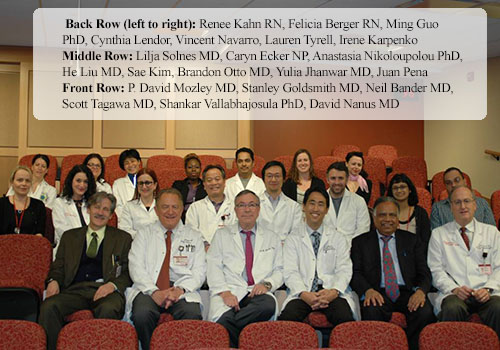
tagawa_team_smWeill Cornell’s Dr. Scott Tagawa and his research team are featured on the  Department of Defense’s Congressionally Directed Medical Research Programs (CDMRP) website as one of the “2013 Prostate Cancer Research Highlights.” The article focuses on Dr. Tagawa’s research of an antibody called J591. J591 specifically recognizes prostate specific membrane antigen (PSMA), allowing prostate cancer cells to be targeted to be specifically targeted. Dr. Tagawa collaborated with Weill Cornell’s Dr. Neil Bander and his team to develop J591.

J591 was attached to a tiny radioactive particle called 177Lu. 177Lu-J591 seeks out prostate cancer cells and delivers a lethal dose of radiation to the areas of cancer, but not to normal areas. The researchers have been utilizing J591 in menwith metastatic prostate cancer for over a decade, with success in targeting metastatic tumors and decreases in PSA, tumor size, and pain symptoms.

The Defense Department’s Prostate Cancer Research Program Clinical Trial Award allowed the researchers to expand clinical testing of J591 through a multi-site, phase 2 clinical trial combining hormonal therapy with targeted J591 radiation. The researchers plan to initiate a Phase 3 trial of the radiolabeled J591.

Click here to read the CDMRP article.

Weill Cornell’s Dr. Scott Tagawa Presents Positive Results of ATL101 at ASCO

ATLAB Pharma SAS announced that positive results of a phase II study of ATL101 (Lutetium-177 anti-PSMA antibody) on 47 patients with progressive metastatic castrate-resistant prostate cancer (mCRPC) have been presented at the ASCO 2013 Genitourinary cancer meeting.

Weill Cornell’s Dr. Scott Tagawa presented the results and the survival update. The study was performed at Weill Cornell Medical College/NewYork-Presbyterian Hospital and Memorial Sloan-Kettering Cancer Center.

ATL101 is a new targeted radiotherapy experimental drug for treating prostate cancer. ATL101 combines the humanized J591 monoclonal antibody targeting prostate-specific membrane antigen (PSMA) plus the Lutetium-177 radioisotope, creating the first tumor-specific delivery system able to target radiation to radio-sensitive prostate cancer cells wherever they are in the body.

In the study, ATL101 was administered as a single intravenous injection at 2 radioactivity dose levels, 65 or 70 mCi/m^2, in two consecutive cohorts of patients with metastatic castration-resistant prostate cancer (mCRPC). A third cohort was added at the 70mCi/m^2 dose. All patients had failed up to 4 hormonal therapies, and 55% of the patients had failed at least one docetaxel-containing chemotherapy regimen.

The results suggested a statistically significant relationship between injected dose and antitumor activity. The percentage of patients achieving PSA decline over 30% (30% PSA decline) increased from 13 % in Cohort (1) to 47 % in Cohort (2). The expansion Cohort 3 confirmed the rates of 30% PSA decline at 47% of patients. A treatment effect on the circulating tumor cells (CTC) count was also observed. Moreover, median overall survival (OS) significantly increased with the injected dose of radioactivity from 11.9 months in cohort (1) to 21.8 months in cohorts 2 and 3. The treatment was well tolerated with predictable, transient, and manageable dose-related changes in blood cell counts. Patients experienced no serious symptomatic side effects.

ATL101 is actively studied at Weill-Cornell Medical College/New York-Presbyterian Hospital in Phase I trials evaluating fractionated administration and combination with docetaxel. In addition, a randomized, multi-centre Phase II trial of ATL-101 in patients who have relapsed following surgery and/or radiation therapy and hormonal therapy but who do not yet have demonstrable metastatic disease is ongoing at several clinical sites in the USA. Click here to view the Phase II trial at clinicaltrials.gov.