Moonshot Summit: Changing Cancer As We Know it

DAVID NANUS, MD

DrNanus_Cancer Moonshot Summit
Photo credit: Ira Fox

On June 29, Weill Cornell Medicine and NewYork-Presbyterian Hospital joined more than 270 institutions across the country in holding a Moonshot Summit. These summits were held in conjunction with Vice President Biden’s Moonshot initiative to fight cancer. On this national day of action, cancer experts throughout our institution, survivors, and advocates came together to share their ideas for increased collaboration and cures.

The summit conversation started with a constructive dialogue about clinical trials and the unfortunate fact that for many cancer types, the “standard of care” chemotherapies are not good enough. At Weill Cornell Medicine and NewYork-Presbyterian, immunotherapies and precision medicine are opening new doors in cancer treatment, but sadly not all patients currently have access to these types of cutting-edge treatments.

Moonshot Summit_23
A packed room at the Weill Cornell Medicine/NewYork-Presbyterian Hospital Cancer Moonshot Summit (photo credit: Ira Fox)

Clinical trials may have gotten a bad rap in the past, but they are a powerful tool to access innovative treatments. The speakers agreed that clinical trials should be easily accessible to all patients, but at times there are obstacles. These range from lengthy forms that deter enrollment, to bureaucracy that slows the timeline for opening new clinical trials, to disinterest and concerns about the treatments’ effectiveness. On a global scale, there has been a lack of adult participation in cancer clinical trials, while for children we actually see the opposite trend – very high enrollment. What can we learn from this information?

Moonshot Summit_14
(L-R) Dr. Gail Roboz and Dr. Susan Pannullo speaking at the Cancer Moonshot Summit (photo credit: Ira Fox)

One of my colleagues Dr. Gail Roboz wisely stated, “I always tell my patients, be afraid of the disease, not the treatment.” She’s right in that we need to reframe the conversation to focus on making strides in increasing cure rates through new research that leads to new treatment breakthroughs across disease states.

We also talked about access to care. Not all patients are able to get a correct diagnosis quickly. This can be due to a variety of reasons including a lack of access to specialists, living in a rural area, or financial limitations. By increasing government research funding, as well as making it easier for patients to reach quality care, we can remove some of these barriers nationally. If we increase the number of people who are diagnosed with cancer early on, we can increase the cure rates. Additionally, as a country, we need to provide comprehensive care for patients and families and always put the interests of patients first. This includes offering supportive services beyond just the best medical care.

I felt so empowered by my colleagues and our patients’ great ideas about how we can overcome the challenges we face in cancer care. The Cancer Moonshot initiative is giving high hopes to many and will help ultimately change the world of cancer care as our country stands together with common goals and a renewed commitment to collaboration. By bringing everyone together at an event like this, we hear diverse perspectives and glean new insights. The fight against this terrible disease truly unites us all.

Moonshot Summit_17
Photo credit: Ira Fox

Stereotactic Body Radiation for Prostate Cancer

JOSEPHINE KANG, MD, PhD

Linear Accelerator Stereotactic Body Radiation
One of the linear accelerators used to deliver stereotactic body radiation therapy (SBRT) for prostate cancer at Weill Cornell Medicine/NewYork-Presbyterian Hospital

Advances in radiation therapy have enabled physicians to deliver high doses of radiation treatment with extreme precision, shortening treatment duration and reducing exposure to normal organs. For men with localized prostate cancer that hasn’t spread outside the prostate gland, this has led to radiation treatments that can be completed within just five treatments.

Initially this approach was developed on the Cyberknife Radiosurgery Platform. Cyberknife radiosurgery doesn’t actually refer to a knife or traditional “surgery,” but rather a specific type of machine that delivers radiation. Now, this five-treatment radiation for prostate cancer can be delivered using many different types of radiation machines, and as a result has undergone a bit of a name change. We now refer to this treatment as “stereotactic body radiation” or SBRT for short.

There are multiple reasons to select SBRT as treatment for prostate cancer. First, it only requires a total of five treatments over the span of one to two weeks, in contrast to standard external beam radiotherapy, which requires nine weeks of daily treatments. Additionally, prostate cancer success rates from SBRT appear comparable to other treatment modalities based on monitoring for up to nine years post-treatment. These outcomes were recently reported at the 2016 American Society of Clinical Oncology (ASCO) Genitourinary meeting.

This retrospective study reflects the longest follow up monitoring to date and demonstrates local control of the cancer, with nine-year freedom from PSA failure (rise of 0.2 ng/ml above nadir) of 95% for low-risk patients, 89% for intermediate-risk patients, and 66% for high-risk patients (determined based on National Comprehensive Cancer Network risk criteria). In the study, toxicity from radiation was low, and the dose utilized was 7.0 – 7.25 Gy per fraction. In prostate SBRT, appropriate treatment dosing is critical as higher doses have been linked with unacceptably high rates of toxicity. At the level used in the study, patients reported some bowel and urinary side effects that lasted less than one year. Overall, this study suggests that increased radiation doses and additional hormonal therapy did not improve outcomes; however, prospective studies are ongoing.

There is now enough data regarding using SBRT for prostate cancer treatment that it is an accepted treatment regimen by the American Society of Radiation Oncology (ASTRO), and the National Comprehensive Cancer Network (NCCN) guidelines. However, these guidelines explicitly state that prostate SBRT should, when elected, be performed at a center with high-volume and expertise. The physicians at Weill Cornell Medicine and NewYork-Presbyterian are very experienced in delivering SBRT for localized prostate cancer and have published many articles on this approach and when it should be used.

We will soon be opening a randomized study looking at prostate SBRT in conjunction with rectal spacer versus endorectal balloon in an ongoing effort to refine our treatments. The rectal spacer is a gel, placed between the prostate and rectum. By displacing the rectum from the prostate, it reduces exposure of the rectal wall to radiation. The spacer degrades over a period of three months and has been shown to reduce toxicity in patients undergoing standard external beam radiation therapy. We hypothesize that there will be similar toxicity reduction after SBRT. An endorectal balloon is another way to reduce overall rectal wall dose, by pushing the posterior rectal wall away from the prostate during radiation treatment.

As data for prostate SBRT continues to mature, more individuals with low- and intermediate-risk prostate cancer will likely opt for this convenient and efficacious form of radiation over more protracted courses.

Hi-Tech Blood Biomarker Signals When a Strategic Switch in Chemotherapy Will Benefit Prostate Cancer Patients

For men with metastatic prostate cancer that grows despite hormonal therapy (also referred to as castration-resistant prostate cancer), chemotherapy has been a mainstay. The class of chemotherapy that has consistently proved to improve survival for men with advanced prostate cancer is called “taxanes.”

Taxanes target microtubules, which are structures in cells that are involved in cell division, as well as the trafficking of important proteins. In prostate cancer, one of the main ways taxane chemotherapy works to kill the cancer cells involves blocking the movement of the androgen receptor (AR) along the microtubule “tracks” towards the cell nucleus, a mechanism we discovered here at Weill Cornell Medicine.

There are two taxanes FDA-approved to treat prostate cancer, docetaxel (brand name: Taxotere) and cabazitazel (brand name: Jevtana). While the drugs are similar, men whose tumors have grown despite taking one drug often respond to the other. The challenge for oncologists has been pinpointing when exactly to switch treatments.

ScottTagawa_ASCO2016_TAXYNERGYDr. Scott Tagawa presented exciting results from a phase II clinical trial at the 2016 American Society for Clinical Oncology (ASCO) annual meeting demonstrating the power of this treatment switch, and when to make the switch.

This research came to be because we thought that we might be able to increase the number of men who respond to taxane chemotherapy with an early assessment and by changing the drug for those who have a sub-optimal response. Simply put, those with no response or only an initial minor response had their drug changed at a much earlier time point then standard practice. This resulted in a higher response rate for the patients in the study.

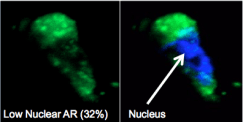
Top Boxes_Taxynergy
In the photos from a sub optimally responding patient, almost all of the androgen receptor (AR, labeled in green) is in the nucleus (indicated by the arrow which is overlayed in blue on the right), meaning that the taxane chemotherapy treatment was unable to block AR from moving to the nucleus and thus unable to kill the prostate cancer cells.

In addition, it’s very exciting that we can examine cancer cells from a simple blood test, a process also referred to as collecting circulating tumor cells or CTCs. This allows us to assess the ability of a drug to target the pathway in real time and to tell us whether there is a positive tumor response or resistance.

These circulating tumor cells provide an opportunity for real-time molecular analysis of taxane chemotherapy and at Weill Cornell Medicine we’ve pioneered a way to examine the AR pathway with a simple blood test.

To do this we use an extremely specialized technology that captures the very small fragments or rare circulating tumor cells on a “chip.” From this chip we are able to determine which cells are responding to treatment.

Bottom Boxes_Taxynergy
In real time, we can see taxane chemotherapy kept the (green) AR out of the (blue) nucleus area in cells from a responding patient. 

In cancer care, we are always trying to maximize treatment response rates by targeting the right cells at the right time. This promising precision medicine approach offers us one more tool to better personalize treatment and improve outcomes.