What’s Next for Cutting-Edge Bladder Cancer Treatment?

AN UPDATE ON ATEZOLIZUMAB, AN IMMUNOTHERAPY

Dr. David Nanus, Chief of Hematology and Medical Oncology at Weill Cornell Medicine and NewYork-Prebysterian Hospital and genitourinary (GU) cancer expert, sat down with OncLive TV to discuss future research efforts and next steps for a new immunotherapy drug for patients with bladder cancer. This drug, atezolizumab (brand name Tecentriq), is the first new drug that has been FDA-approved for urothelial carcinoma – the most common type of bladder cancer – in over two decades.

Atezolizumab works by detecting a specific protein (PD-L1) on the surface of tumor cells, allowing the body’s immune system to recognize the cancer and attack it. Ongoing research on this treatment has revealed some complexities that have left physicians and researchers with questions ripe for scientific exploration, especially since this is a newer drug lacking long-term clinical data.

Two important questions remain regarding atezolizumab:

1. Are there biomarkers we can use for this drug?
2. For how long should this drug be administered?

The first question involves “biomarkers” or “biological markers,” indicators in the body that can be measured or tracked. In cancer treatment, oncologists use different biomarkers to glean information about a patient’s diagnosis and prognosis, as well as to monitor treatment effectiveness. Biomarkers can also offer information about safety of a treatment and signal which patients will benefit most from a certain drug. Currently, we do not yet have any biomarkers to predict whether atezolizumab will work. In a recent interview with OncLive TV, Dr. Nanus explains this uncertainty by saying, “There is not going to be one simple biomarker that is going to say to treat or not treat, so that is the unanswered question.”

The second question pertains to duration of treatment. Researchers and physicians are still working to find out when atezolizumab can be safely stopped without losing its benefit, and if the drug can be re-administered in the case of cancer recurrence or relapse. The “right” length of treatment is also linked with cost-effectiveness and accessibility for all patients in need since this drug is very expensive.

These questions are global issues that pertain to many new and emerging cancer treatments, especially immunotherapies that leverage the body’s own immune system to fight the tumors. Immunotherapies are drastically changing the way many cancers are treated, but we still have much more to learn. It is only with time and additional research that we will find the answers to both of these questions.

Hear from Dr. Nanus firsthand:

Freedom from Cancer

Fireworks_Fourth of JulyThis Fourth of July holiday, we’re not only celebrating the red, white and blue that honors the independence and freedom of our country, but also freedom from cancer and the cancer “blues.” Feeling this sense of freedom may mean that you’re cancer-free or that you’re unwilling to let a cancer diagnosis define you.

To be cancer-free means that tests show no evidence of any cancer remaining in the body, a term coined “complete remission.” In some cases, it is possible to complete treatment but still have some evidence of the cancer. This is called “partial remission.”

At Weill Cornell Medicine and NewYork-Presbyterian Hospital, many of our patients and their families experience a wide range of emotions during and after treatment for kidney, prostate, bladder and testicular (genitourinary or “GU”) cancers. Often, freedom from cancer is both something to celebrate and something that comes with an air of caution. That’s because the joy of being cancer-free may be accompanied by fear that the cancer may return.

Some cancers can and do come back after treatment. This is called “recurrence.” Recurrence can depend on several factors, including the type of cancer, whether it has spread from the original source and how the cancer responded to treatment. While there is no foolproof way to keep cancer from coming back, there are many things you and your healthcare team can do to monitor what’s going on in your body.

You may feel differently than you did before treatment, both physically and mentally. And that’s okay. It’s important to be in tune with your body and your new normal so that you can be mindful of any bodily changes.

It’s also important for cancer patients and survivors to lead a healthy lifestyle. This includes eating a healthy diet, being physically active (under the supervision of your healthcare team), and regularly following up with doctors’ appointments and routine medical tests. Cancer survivors can live very long and full lives, so routine medical tests and appointments aren’t limited to following up with your oncologist and getting scans and imaging tests. It’s important to also get regular physical exams and monitor other markers for diseases such as cholesterol, diabetes, high blood pressure and heart disease.

Routine follow-up tests may also identify the recurrence of cancer even before symptoms develop. Since cancer can come back in the same part of the body or in another part of the body, signs and symptoms may differ from those involved with your original diagnosis. For instance, an increase in fatigue, the development of new pain or worsening of existing pain, weight loss, urinary changes (including blood in urine), and other changes in the way you feel should be discussed with your physician, especially those that persist.

This Independence Day, as you enjoy time with your family, watching fireworks, and celebrating other traditions, take a moment to think about independence from cancer. Our support groups can help by providing a safe space and community for prostate cancer and kidney cancer survivors, patients and their families.

Have a wonderful holiday!

Hi-Tech Blood Biomarker Signals When a Strategic Switch in Chemotherapy Will Benefit Prostate Cancer Patients

For men with metastatic prostate cancer that grows despite hormonal therapy (also referred to as castration-resistant prostate cancer), chemotherapy has been a mainstay. The class of chemotherapy that has consistently proved to improve survival for men with advanced prostate cancer is called “taxanes.”

Taxanes target microtubules, which are structures in cells that are involved in cell division, as well as the trafficking of important proteins. In prostate cancer, one of the main ways taxane chemotherapy works to kill the cancer cells involves blocking the movement of the androgen receptor (AR) along the microtubule “tracks” towards the cell nucleus, a mechanism we discovered here at Weill Cornell Medicine.

There are two taxanes FDA-approved to treat prostate cancer, docetaxel (brand name: Taxotere) and cabazitazel (brand name: Jevtana). While the drugs are similar, men whose tumors have grown despite taking one drug often respond to the other. The challenge for oncologists has been pinpointing when exactly to switch treatments.

ScottTagawa_ASCO2016_TAXYNERGYDr. Scott Tagawa presented exciting results from a phase II clinical trial at the 2016 American Society for Clinical Oncology (ASCO) annual meeting demonstrating the power of this treatment switch, and when to make the switch.

This research came to be because we thought that we might be able to increase the number of men who respond to taxane chemotherapy with an early assessment and by changing the drug for those who have a sub-optimal response. Simply put, those with no response or only an initial minor response had their drug changed at a much earlier time point then standard practice. This resulted in a higher response rate for the patients in the study.

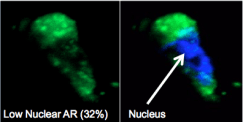
Top Boxes_Taxynergy
In the photos from a sub optimally responding patient, almost all of the androgen receptor (AR, labeled in green) is in the nucleus (indicated by the arrow which is overlayed in blue on the right), meaning that the taxane chemotherapy treatment was unable to block AR from moving to the nucleus and thus unable to kill the prostate cancer cells.

In addition, it’s very exciting that we can examine cancer cells from a simple blood test, a process also referred to as collecting circulating tumor cells or CTCs. This allows us to assess the ability of a drug to target the pathway in real time and to tell us whether there is a positive tumor response or resistance.

These circulating tumor cells provide an opportunity for real-time molecular analysis of taxane chemotherapy and at Weill Cornell Medicine we’ve pioneered a way to examine the AR pathway with a simple blood test.

To do this we use an extremely specialized technology that captures the very small fragments or rare circulating tumor cells on a “chip.” From this chip we are able to determine which cells are responding to treatment.

Bottom Boxes_Taxynergy
In real time, we can see taxane chemotherapy kept the (green) AR out of the (blue) nucleus area in cells from a responding patient. 

In cancer care, we are always trying to maximize treatment response rates by targeting the right cells at the right time. This promising precision medicine approach offers us one more tool to better personalize treatment and improve outcomes.