
Doing Better on Behalf of Bladder Cancer Patients

Scott Tagawa_IMG_5903On Monday, April 18th, Dr. Scott Tagawa presented promising bladder cancer clinical trial results at the 2016 AACR Annual Meeting.

This phase II study of the antibody-drug conjugate (IMMU-132), demonstrated positive results in a group of adults with metastatic urothelial cancer who did not respond to standard chemotherapies or relapsed after receiving several rounds of the standard chemotherapy treatment regimens.

A form of immunotherapy, antibody drug conjugates are a targeted therapy that leverages the capability of monoclonal antibodies to attach to specific targets on cancer cells. By attaching a drug to the monoclonal antibodies, treatments are able to “hitch a ride” into the cancer cells.

“In this study, eighty-four percent of patients were alive at the nearly one-year mark, compared with an average overall survival of 4-9 months in similar patients who received chemotherapy regimens,” says Dr. Tagawa.

Some side effects were reported, including neutropenia, a low count of a type of white blood cells (neutrophils) in the blood and some diarrhea, but less than would be expected with the free form of the parent drug irinotecan. Irinotecan is a chemotherapy drug mostly used for the treatment of colon cancer. In the body, it is metabolized and breaks down into SN38, which is a more potent molecule. Because of its potency, it would be too toxic to deliver SN38 into the body in general.

IMMU-132 is a drug in which SN38 is linked to an antibody which recognizes Trop2. Trop2 is a protein in the surface of several different types of cells and is over-expressed on many common cancer types, including urothelial cancer. Since the drug shuttles SN38 preferentially into tumors, patients benefit from the potent drug without as many side effects as general chemotherapy.

This drug is also known as Sacituzumab Govitecan, and has already received FDA-breakthrough designation for the treatment of patients with triple negative breast cancer.

The Weill Cornell Medicine clinical trial continues to enroll patients with advanced urothelial cancers (tumors arising from the bladder, renal pelvis, and ureters). For more information about eligibility and enrollment, click here.
What a Simple Blood Test Can Reveal About Chemo and Prostate Cancer

From our personalities to our hair and eye colors, genetic variations make us who we are. When it comes to cancer, genetic variations can also share insights into who is most likely or least likely to respond to a particular treatment.

For people with advanced prostate cancer, taxane chemotherapy is the only chemo shown to improve survival. There are specific genetic markers evident in the blood that can tell us whether men are likely to respond to this treatment approach.

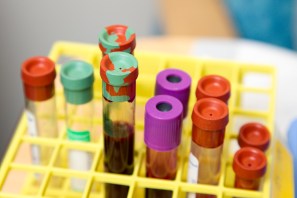
blood draw vials
Photo credit: National Cancer Institute (NCI)

Through a simple blood draw, we can isolate the presence of circulating tumor cells (cells that the tumor sheds into the bloodstream), to determine if men with prostate cancer have the most common and well-documented genetic variant, AR-v7. If patients have the AR-v7 variant, AR-targeted drugs, such as taxane chemotherapies won’t work effectively. This is because these therapies target the cells where testosterone binds (hormonal therapies). People with the AR-v7 variant are missing this binding location, so the hormonal therapies don’t work. It’s important to know this upfront, before starting treatment.

The second most common genetic variant we can test for is ARv-567-es. This variant actually has the opposite effect. Instead of indicating that taxanes won’t work, it indicates that taxane chemotherapies will work very well.

Unfortunately, cancer cells are pretty smart (and sneaky), so they adapt. As a result, all tumors ultimately develop drug resistance to taxanes. How the cancer cells adapt is not well-understood. With the support of the Movember Foundation and the Prostate Cancer Foundation, Weill Cornell Medicine is part of a multi-institutional initiative to study this further and ultimately find ways to prevent this resistance from occurring.

We’ve previously determined that the genetic alteration known as TMPRSS2-ERG leads to taxane resistance because ERG binds to tubulin, the molecular binding target for taxane chemotherapy. This creates a “road-block” that prevents the chemotherapy from working.

Independently, the presence of AR-v7 or ERG is already known to cause prostate cancer patients to stop responding to taxane chemotherapy. At AACR 2016, we presented new research on how ERG and AR-v7 may serve as co-conspirators when it comes to developing taxane resistance. We found that in 70% of ERG-positive advanced, metastatic prostate cancer patients, AR-v7 was also present. In this study, we also determined that ERG and AR-v7 bind together and form a protein complex. We are currently examining whether this complex targets specific genes in the cell that are known to facilitate the growth and progression of prostate cancer.

We can detect the presence of ERG and AR-v7 through non-invasive “liquid biopsies.” By isolating circulating tumor cells and analyzing the presence of genetic alterations with cutting-edge technologies, we are able to quickly determine whether a patient will respond well or show resistance to taxane chemotherapy. If we determine that someone will be resistant, we can then recommend a more effective treatment approach, saving patients time and preventing exposure to unnecessary toxicity.

Additionally, at AACR 2016, the labs of Drs. Elemento and Giannakakou presented new research using sophisticated computer software analysis to examine large datasets derived from circulating tumor cells from the blood of men with advanced prostate cancer. This method was effective in identifying gene expression differences, mutations and communication pathways within the cells that promote cancer progression.

Our ongoing research aims to use this method to analyze circulating tumor cells from patients before, during and after taxane chemotherapy treatment in order to detect differences that could be the cause of treatment resistance.

Aggressive Prostate Cancers: What’s New in Research and Treatment?

This year, approximately 180,000 men in the United States will be diagnosed with prostate cancer. Prostate cancer comes in many forms and we have a slew of acronyms to help us categorize not just the stage of the prostate cancer, but its various sub-types. These sub-types are based on biological markers and the genetic makeup of the tumor and tell us a lot about how the tumor may behave. We have even found that these tumor cells can change over time to avoid detection, and in the process they can become resistant to treatments.

Aggressive prostate cancer sub-types represent approximately 25% of all prostate cancer cases. A common treatment for aggressive prostate cancer that hasn’t spread (non-metastatic prostate cancer) is “castration” through surgery or other therapies to deplete the androgen and testosterone hormones that feed the tumor.

Castration-resistant prostate adenocarcinoma or CRPC is the medical term for prostate cancer that does not respond to these therapies. Adenocarcinoma is a fancy way of saying a glandular cancer, an umbrella term for cancers that originate in different glands in the body, of which the prostate is one.

fish_lg
Microscopic images of aggressive prostate cancers. Top: castration-resistant prostate cancer (CRPC) Bottom: Neuroendocrine prostate cancer (NEPC)

New and emerging research has shown that CRPC can evolve and morph into neuroendocrine prostate cancer (NEPC), another aggressive type of prostate cancer. The mechanism by which this happens is not yet completely known, but at Weill Cornell Medicine we’re hard at work to discover the answers.

On a molecular level, neuroendocrine prostate cancers are associated with over-expression and gene amplification of MYCN (the gene that encodes the N-Myc protein). MYCN is a gene that has been proven to drive cancer (a.k.a. an oncogene) in several rare tumor types, but the role it plays in the progression of prostate cancer has not yet been well established.

On Sunday, April 17th at the 2016 American Association for Cancer Research (AACR) Annual Meeting, Dr.
Rickman and colleagues
showed that by integrating a novel genetically-engineered mouse model and human prostate cancer transcriptome data (the product of the genes that were expressed in those patients’ tumors), N-Myc over-expression leads to the development of poorly differentiated, invasive prostate cancer that is similar to human neuroendocrine prostate cancer tumors on molecular and histological levels.

NMYC slide[1] copyThis research also demonstrated that N-Myc over-expression sensitizes cells to specific inhibitors targeting epigenetic modifiers that are linked to neuroendocrine prostate cancers. In plain language, this means that the controllers of the genes (the epigenome) in NEPC may be especially sensitive to certain drugs (such as EZH2 inhibitors that are in the clinic currently). This provides strong rationale for developing additional new therapeutic strategies in order to treat this aggressive subtype of prostate cancer more effectively and prevent it from becoming neuroendocrine prostate cancer.

For more information about our open clinical trial using an EZH2 inhibitor, please contact Amelyn Rodriguez, RN at amr2017@med.cornell.edu or (212) 746-1362.