
Movember 2016

Movember_Drs Nanus Beltran TagawaFor the 7th year in a row, we are proud to participate in a month-long campaign to raise awareness and funds for men’s health issues each November, also known as Movember.

The Movember Campaign helps men live happier, healthier and longer lives through investing in prostate cancer and testicular cancer screening and research, as well as mental health issues.

What’s Movember?

The initiative started in Australia in 2003, when two friends decided to try to bring back the moustache trend by growing out moustaches during the month of November. The following year, after they realized that this facial hair was quite the conversation-starter, they decided to channel that energy to raise money for prostate cancer research.

Over the next few years, both the moustaches and audiences grew. The fundraiser gained traction in Australia and New Zealand. In 2007, Movember officially launched globally with partnerships in the United States, Canada, United Kingdom and Spain, all with one cause in mind – to change the face of men’s health – literally and figuratively through increased awareness and funds.

movember_group_wgcToday, more than 5 million “Mo Bros” and “Mo Sistas” from more than 20 countries around the world have collectively raised over $700 million dollars to fund 1,200 men’s health projects.

How can you get involved?

A number of different ways!

  1. Join our Movember team. Our team, the Wild Weill Cornell Mos, is committed to raising awareness and funds for a cause that is near and dear to our hearts.
  2. Grow a moustache. How low can you grow? Make a statement! Commit to going razor-free and growing a moustache in solidarity this month. It’s a great conversation starter to encourage friends and family members to donate to Movember.
  3. Get moving! Take the Move challenge and increase your physical activity. You can “Fly for the Guys” by teaming up with us at two special Flywheel spin classes to benefit the Wild Weill Mos Movember Team. Never taken a spin class before? This is the perfect opportunity to try it out, and there will be many beginners. Mark your calendars and sign up today:
  1. Make a donation. Donate now to support our team.
  2. Get checked. Research shows that many men only go to the doctor when they’re sick. In honor of Movember, make an appointment to visit your doctor for an annual physical or encourage a loved one to visit the doctor. Many diseases can be prevented or at least treated when caught early, including cancer.
  3. Socialize and celebrate with us at Draught 55 on Thursday, December 1st. 100% of the proceeds from ticket sales will be matched and donated to Movember.

What type of research has been funded by Movember?

Movember is committed to funding research that will halve the number of deaths from prostate and testicular cancer by 2030. The Prostate Cancer Foundation (PCF), one of our partners in research, is partnered with Movember to distribute funds to the most worthy scientific teams and projects.
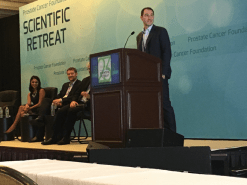
pcf-retreatWe at Weill Cornell Medicine have been fortunate to receive many of these grants over the past several years. Some of these recent Movember-PCF Challenge Grants have funded our research to study:

  • Blood tests that assess the tumor’s circulating DNA to predict reasons for treatment resistance
  • Circulating tumor cell (CTC) tests to predict which patients are more or less likely to respond to hormonal therapy or chemotherapy
  • Assessing the genome of “primary” tumors (i.e. the initial tumors in the prostate) compared to advanced, treatment resistant tumors
  • Evaluating inflammation in adipose (fat) tissue around the prostate, which is associated with tumor growth.

Learn more about the cutting-edge research funded by the PCF-Movember Challenge Grants in 2016, 2015 and 2014.

Stereotactic Body Radiation for Prostate Cancer

JOSEPHINE KANG, MD, PhD

Linear Accelerator Stereotactic Body Radiation
One of the linear accelerators used to deliver stereotactic body radiation therapy (SBRT) for prostate cancer at Weill Cornell Medicine/NewYork-Presbyterian Hospital

Advances in radiation therapy have enabled physicians to deliver high doses of radiation treatment with extreme precision, shortening treatment duration and reducing exposure to normal organs. For men with localized prostate cancer that hasn’t spread outside the prostate gland, this has led to radiation treatments that can be completed within just five treatments.

Initially this approach was developed on the Cyberknife Radiosurgery Platform. Cyberknife radiosurgery doesn’t actually refer to a knife or traditional “surgery,” but rather a specific type of machine that delivers radiation. Now, this five-treatment radiation for prostate cancer can be delivered using many different types of radiation machines, and as a result has undergone a bit of a name change. We now refer to this treatment as “stereotactic body radiation” or SBRT for short.

There are multiple reasons to select SBRT as treatment for prostate cancer. First, it only requires a total of five treatments over the span of one to two weeks, in contrast to standard external beam radiotherapy, which requires nine weeks of daily treatments. Additionally, prostate cancer success rates from SBRT appear comparable to other treatment modalities based on monitoring for up to nine years post-treatment. These outcomes were recently reported at the 2016 American Society of Clinical Oncology (ASCO) Genitourinary meeting.

This retrospective study reflects the longest follow up monitoring to date and demonstrates local control of the cancer, with nine-year freedom from PSA failure (rise of 0.2 ng/ml above nadir) of 95% for low-risk patients, 89% for intermediate-risk patients, and 66% for high-risk patients (determined based on National Comprehensive Cancer Network risk criteria). In the study, toxicity from radiation was low, and the dose utilized was 7.0 – 7.25 Gy per fraction. In prostate SBRT, appropriate treatment dosing is critical as higher doses have been linked with unacceptably high rates of toxicity. At the level used in the study, patients reported some bowel and urinary side effects that lasted less than one year. Overall, this study suggests that increased radiation doses and additional hormonal therapy did not improve outcomes; however, prospective studies are ongoing.

There is now enough data regarding using SBRT for prostate cancer treatment that it is an accepted treatment regimen by the American Society of Radiation Oncology (ASTRO), and the National Comprehensive Cancer Network (NCCN) guidelines. However, these guidelines explicitly state that prostate SBRT should, when elected, be performed at a center with high-volume and expertise. The physicians at Weill Cornell Medicine and NewYork-Presbyterian are very experienced in delivering SBRT for localized prostate cancer and have published many articles on this approach and when it should be used.

We will soon be opening a randomized study looking at prostate SBRT in conjunction with rectal spacer versus endorectal balloon in an ongoing effort to refine our treatments. The rectal spacer is a gel, placed between the prostate and rectum. By displacing the rectum from the prostate, it reduces exposure of the rectal wall to radiation. The spacer degrades over a period of three months and has been shown to reduce toxicity in patients undergoing standard external beam radiation therapy. We hypothesize that there will be similar toxicity reduction after SBRT. An endorectal balloon is another way to reduce overall rectal wall dose, by pushing the posterior rectal wall away from the prostate during radiation treatment.

As data for prostate SBRT continues to mature, more individuals with low- and intermediate-risk prostate cancer will likely opt for this convenient and efficacious form of radiation over more protracted courses.

ASCO 2016: Updates in Advanced Prostate Cancer and Precision Medicine

Advances in therapeutics have led to improvements in both survival and quality of life for patients with cancer, including men with advanced prostate cancer. Simultaneously, a number of cutting-edge scientific advances have been made in the underlying biology of advanced prostate cancer. There is great potential and power in integrating these new therapeutics and biomarkers, which is often referred to precision medicine. While great advances have already been made in this area, many remain highly sophisticated and restricted to selected centers, such as Weill Cornell Medicine and NewYork-Presbyterian Hospital, while others still need validation in a larger number of patients. Ultimately, the goal is to be able to bring these technologies and treatments to cancer patients all around the country and the world.

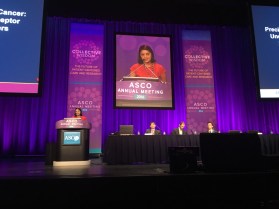
MishaBeltran_ASCO16
Dr. Misha Beltran speaks to a full house at the ASCO 2016 Annual Meeting in Chicago.

At the 2016 ASCO meeting, Dr. Himisha Beltran was the chair of a session entitled “Precision Medicine in Advanced Prostate Cancer: Understanding Genomics, Androgen Receptor Splice Variants, and Imaging Biomarkers.” This session intended to demystify some of the language and updates surrounding precision medicine.

Dr. Beltran spoke about important recent advances in tumor and patient genomics, such as the specific genetic alterations that we now know drive different types of tumors and play a role in the development of aggressive forms of the disease. The Cancer Genome Atlas (TCGA), a government-led initiative through the National Cancer Institute (NCI) has generated multi-dimensional maps for key genomic changes in 33 different types of cancer. It also provides a collaborative platform for physicians and researchers to search, download, and analyze data. Through the TCGA there have been critical discoveries regarding untreated primary prostate tumors with molecular classification of different subtypes that go beyond Gleason scores (the common way pathologists “grade” the aggressiveness of tumors).

Additionally, the first publication of the Stand Up to Cancer Prostate Cancer Dream Team demonstrated the genomic landscape of metastatic biopsies in the castration-resistant setting, which have differences compared to primary prostate tumors and fall into groups which may be targetable by certain therapies. Dr. Mark Rubin is the Weill Cornell Primary Investigator for the Stand Up to Cancer Dream Team. In addition, as follow up to Dr. Beltran’s initial 2011 publication, she detailed the results of Weill Cornell’s collaborative efforts leading to key discoveries in neuroendocrine and castration-resistant prostate cancer using tumor tissue as well as circulating tumor cell analysis.

Collaborator Dr. Gerhardt Attard presented data on utilizing DNA obtained from blood only, an emerging method of accessing the tumor’s genomic information in a non-invasive manner, which may decrease the need for a biopsy and allow for multiple samples to be assessed over time. One clinically relevant portion of his work, being done in collaboration with Drs. Beltran and Francesca DeMichelis, is ongoing through a Prostate Cancer Foundation – Movember Challenge Award grant. Together, we are leveraging our published genomic data on neuroendocrine and treatment-resistant prostate cancer with the circulating tumor DNA from blood technology to assess patients’ cancer status before, during, and after treatment.

In addition to improvements in tumor and blood-based biomarkers, imaging biomarkers are also being investigated. Dr. Michael Morris described standardizing the use of traditional scans to assess prostate cancer progression. In addition, there are a number of molecular imaging modalities that may demonstrate increased sensitivity in the detection of tumors as well as give insight into the biology of individual tumors, highlighted by prostate specific membrane imaging including the New York-based collaboration between Memorial Sloane Kettering Cancer Center and Weill Cornell Medicine investigators.