
Moonshot Summit: Changing Cancer As We Know it

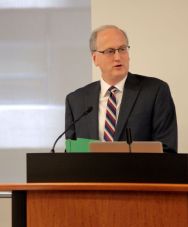
DAVID NANUS, MD

DrNanus_Cancer Moonshot Summit
Photo credit: Ira Fox

On June 29, Weill Cornell Medicine and NewYork-Presbyterian Hospital joined more than 270 institutions across the country in holding a Moonshot Summit. These summits were held in conjunction with Vice President Biden’s Moonshot initiative to fight cancer. On this national day of action, cancer experts throughout our institution, survivors, and advocates came together to share their ideas for increased collaboration and cures.

The summit conversation started with a constructive dialogue about clinical trials and the unfortunate fact that for many cancer types, the “standard of care” chemotherapies are not good enough. At Weill Cornell Medicine and NewYork-Presbyterian, immunotherapies and precision medicine are opening new doors in cancer treatment, but sadly not all patients currently have access to these types of cutting-edge treatments.

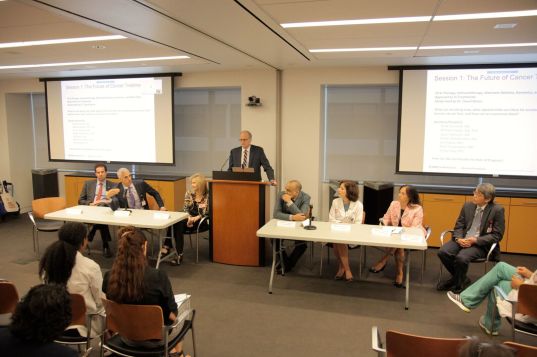
Moonshot Summit_23
A packed room at the Weill Cornell Medicine/NewYork-Presbyterian Hospital Cancer Moonshot Summit (photo credit: Ira Fox)

Clinical trials may have gotten a bad rap in the past, but they are a powerful tool to access innovative treatments. The speakers agreed that clinical trials should be easily accessible to all patients, but at times there are obstacles. These range from lengthy forms that deter enrollment, to bureaucracy that slows the timeline for opening new clinical trials, to disinterest and concerns about the treatments’ effectiveness. On a global scale, there has been a lack of adult participation in cancer clinical trials, while for children we actually see the opposite trend – very high enrollment. What can we learn from this information?
Moonshot Summit_14
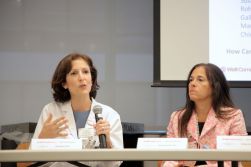
(L-R) Dr. Gail Roboz and Dr. Susan Pannullo speaking at the Cancer Moonshot Summit (photo credit: Ira Fox)

One of my colleagues Dr. Gail Roboz wisely stated, “I always tell my patients, be afraid of the disease, not the treatment.” She’s right in that we need to reframe the conversation to focus on making strides in increasing cure rates through new research that leads to new treatment breakthroughs across disease states.

We also talked about access to care. Not all patients are able to get a correct diagnosis quickly. This can be due to a variety of reasons including a lack of access to specialists, living in a rural area, or financial limitations. By increasing government research funding, as well as making it easier for patients to reach quality care, we can remove some of these barriers nationally. If we increase the number of people who are diagnosed with cancer early on, we can increase the cure rates. Additionally, as a country, we need to provide comprehensive care for patients and families and always put the interests of patients first. This includes offering supportive services beyond just the best medical care.

I felt so empowered by my colleagues and our patients’ great ideas about how we can overcome the challenges we face in cancer care. The Cancer Moonshot initiative is giving high hopes to many and will help ultimately change the world of cancer care as our country stands together with common goals and a renewed commitment to collaboration. By bringing everyone together at an event like this, we hear diverse perspectives and glean new insights. The fight against this terrible disease truly unites us all.
Moonshot Summit_17
Photo credit: Ira Fox

Finding Support in the Kidney Cancer Community

ANA MOLINA, MD

This past Saturday, we hosted our June Kidney Cancer Support Group meeting. This month’s featured speaker was Helen Clark, RN, a clinical nurse educator at the Novartis healthcare group. Every other month I host and facilitate the Weill Cornell Kidney Cancer Support Group to provide a forum to come together, and to learn and talk about a wide-range of topics related to kidney cancer.

At our latest meeting, we discussed several subjects, including two oral medications commonly used in advanced kidney cancer treatment, Votrient (pazopanib) and Afinitor (everolimus). It was a lively conversation about how these medications work, how to cope with and manage common side effects, and how pharmaceutical companies can help with financial issues related to treatment. Additionally, we talked about the process for FDA approval, open clinical trials and other kidney cancer treatments Weill Cornell Medicine has to offer.

The purpose of our support group is to provide a community and outlet for patients and their families and friends, as well as resources and a safe space for sharing and addressing concerns. There is great power in connecting with others who have been there before, and often, it is fellow kidney patients and loved ones who can be the best source of support.

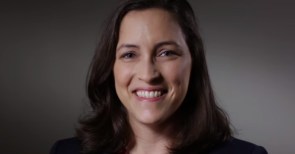
Ana Molina MD
Dr. Molina, Host of the Weill Cornell Kidney Cancer Support Group

Thank you to everyone who came this month! We always like to see new and familiar faces and hope you’ll join us at our next meeting in September. Stay tuned for an update on the date, topic and featured speaker for this session.


ASCO 2016 is Upon Us

Each year, more than 30,000 professionals from around the world come together to discuss groundbreaking research findings at the American Society for Clinical Oncology (ASCO) annual meeting.

This year’s meeting, in Chicago from June 3-7, will feature over 5,000 different abstracts. The Genitourinary (GU) Oncology team will be presenting recent prostate and kidney cancer clinical trial results and updates on using precision medicine to translate genomic information into treatments. Vice President Joe Biden will also be at ASCO to deliver remarks on the Cancer Moonshot Initiative to accelerate cancer research and improve patient care through increased collaboration.

Check out the schedule to see when we’ll be presenting, and be on the lookout for daily “What’s New in GU?” blog updates regarding these noteworthy topics and more:

  • The impact of a split-dose schedule using Lutetium 177, a targeted treatment that has been previously shown to be effective against metastatic prostate cancer
  • The effect of changing prostate cancer chemotherapies early on when one drug doesn’t seem to be working as effectively as it could be, and when to switch
  • How a blood test may be used to detect trace tumor cells in the body and what this reveals about the mechanism behind taxane chemotherapy treatment

ASCO 2016
