
From our personalities to our hair and eye colors, genetic variations make us who we are. When it comes to cancer, genetic variations can also share insights into who is most likely or least likely to respond to a particular treatment.
For people with advanced prostate cancer, taxane chemotherapy is the only chemo shown to improve survival. There are specific genetic markers evident in the blood that can tell us whether men are likely to respond to this treatment approach.
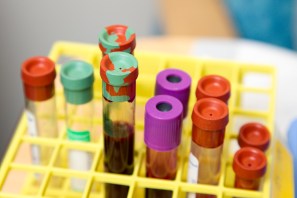
Through a simple blood draw, we can isolate the presence of circulating tumor cells (cells that the tumor sheds into the bloodstream), to determine if men with prostate cancer have the most common and well-documented genetic variant, AR-v7. If patients have the AR-v7 variant, AR-targeted drugs, such as taxane chemotherapies won’t work effectively. This is because these therapies target the cells where testosterone binds (hormonal therapies). People with the AR-v7 variant are missing this binding location, so the hormonal therapies don’t work. It’s important to know this upfront, before starting treatment.
The second most common genetic variant we can test for is ARv-567-es. This variant actually has the opposite effect. Instead of indicating that taxanes won’t work, it indicates that taxane chemotherapies will work very well.
Unfortunately, cancer cells are pretty smart (and sneaky), so they adapt. As a result, all tumors ultimately develop drug resistance to taxanes. How the cancer cells adapt is not well-understood. With the support of the Movember Foundation and the Prostate Cancer Foundation, Weill Cornell Medicine is part of a multi-institutional initiative to study this further and ultimately find ways to prevent this resistance from occurring.
We’ve previously determined that the genetic alteration known as TMPRSS2-ERG leads to taxane resistance because ERG binds to tubulin, the molecular binding target for taxane chemotherapy. This creates a “road-block” that prevents the chemotherapy from working.
Independently, the presence of AR-v7 or ERG is already known to cause prostate cancer patients to stop responding to taxane chemotherapy. At AACR 2016, we presented new research on how ERG and AR-v7 may serve as co-conspirators when it comes to developing taxane resistance. We found that in 70% of ERG-positive advanced, metastatic prostate cancer patients, AR-v7 was also present. In this study, we also determined that ERG and AR-v7 bind together and form a protein complex. We are currently examining whether this complex targets specific genes in the cell that are known to facilitate the growth and progression of prostate cancer.
We can detect the presence of ERG and AR-v7 through non-invasive “liquid biopsies.” By isolating circulating tumor cells and analyzing the presence of genetic alterations with cutting-edge technologies, we are able to quickly determine whether a patient will respond well or show resistance to taxane chemotherapy. If we determine that someone will be resistant, we can then recommend a more effective treatment approach, saving patients time and preventing exposure to unnecessary toxicity.
Additionally, at AACR 2016, the labs of Drs. Elemento and Giannakakou presented new research using sophisticated computer software analysis to examine large datasets derived from circulating tumor cells from the blood of men with advanced prostate cancer. This method was effective in identifying gene expression differences, mutations and communication pathways within the cells that promote cancer progression.
Our ongoing research aims to use this method to analyze circulating tumor cells from patients before, during and after taxane chemotherapy treatment in order to detect differences that could be the cause of treatment resistance.

![NMYC slide[1] copy](https://weillcornellgucancer.org/wp-content/uploads/2016/04/nmyc-slide1-copy.jpg?w=356&h=267) This research also demonstrated that N-Myc over-expression sensitizes cells to specific inhibitors targeting epigenetic modifiers that are linked to neuroendocrine prostate cancers. In plain language, this means that the controllers of the genes (the epigenome) in NEPC may be especially sensitive to certain drugs (such as EZH2 inhibitors that are in the
This research also demonstrated that N-Myc over-expression sensitizes cells to specific inhibitors targeting epigenetic modifiers that are linked to neuroendocrine prostate cancers. In plain language, this means that the controllers of the genes (the epigenome) in NEPC may be especially sensitive to certain drugs (such as EZH2 inhibitors that are in the 
 What's New in GU?